Sölvesborgs slott, Medieval fortress ruins in Sölvesborg, Sweden.
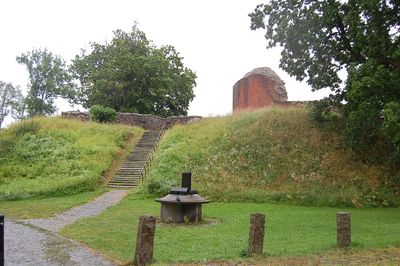
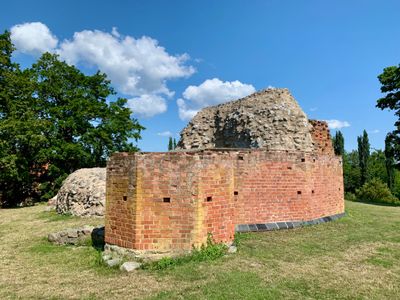
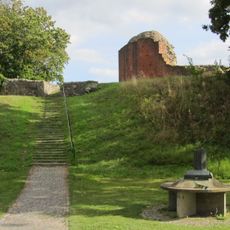
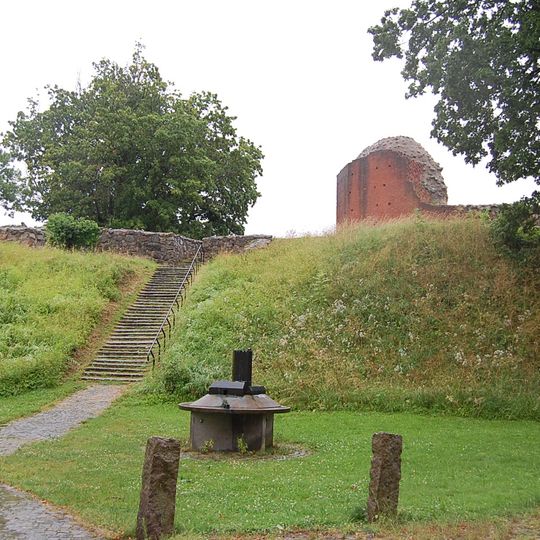
Sölvesborgs slott is a ruined castle on a raised mound about 500 metres northeast of Sölvesborg's medieval centre. Its surviving round tower, built of red brick in shell-wall technique with a stone and mortar core, stands about 11 metres high and 17 metres in diameter, with walls 5.5 metres thick. A deep cellar room remains, and a 15-metre-wide moat once encircled the mound.
The fortress was founded in the early 14th century as a Danish stronghold and controlled vital trade routes between Danish Blekinge and Swedish Småland. It was destroyed in 1564 after enduring repeated conflicts and military pressure from competing regional powers.
The name "slott" comes from the castle's use as overnight lodging for royalty, which led people to call it the castle. Queen Margareta of Denmark and Erik of Pommern stayed here often in the early 1400s, and in 1402 they held a meeting with Danish and Swedish councillors. A legend says Admiral Sören Norby buried a treasure here under copper hatches in the 1500s, but excavations found nothing.
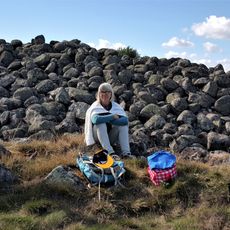
The ruin sits on a raised mound about 500 metres northeast of Sölvesborg's medieval centre, reached by a long stone staircase up the slope. The ground around the walls is uneven, and the deep cellar room preserved beneath the former tower can be entered. Sturdy shoes help on the grass and stone.
The original tower was roughly twice as tall as what remains today and featured an unusual hexagonal base that transitioned to an octagonal shape in its upper section. This design was an architectural rarity for the period and set it apart from other fortifications in the region.
The community of curious travelers
AroundUs brings together thousands of curated places, local tips, and hidden gems, enriched daily by 93,308 contributors worldwide.