Carl Johans park, Public park in Norrköping, Sweden.
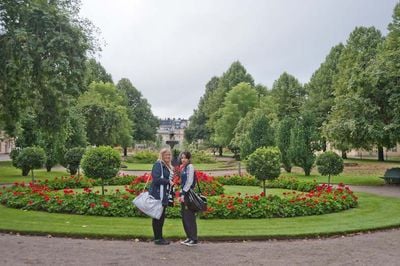
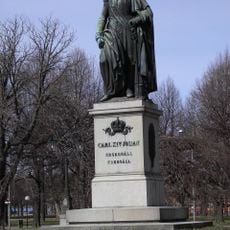
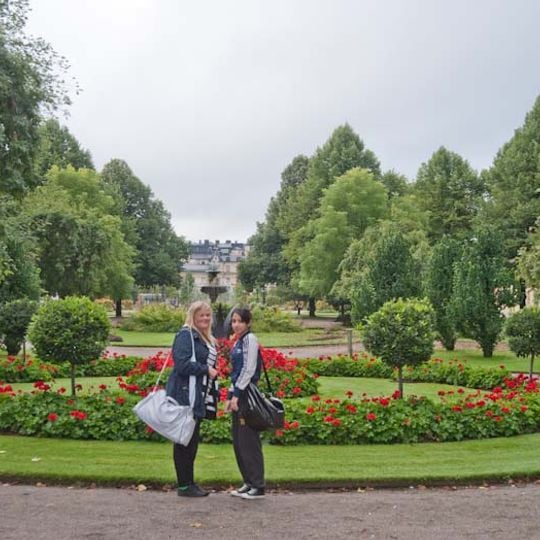
Carl Johans park is a park in Norrköping, laid out in 1887 on the former Carl Johans torg square. Its southern section was designed by city architect Carl Theodor Malm with lawns, symmetrically patterned paths, unusual trees and flower beds. Around the bronze statue of Karl XIV Johan, beds hold houseleeks, sedum and echeveria, and since 1926 the Kaktusplanteringen motif bed has been replanted each year with a new theme.
The site was originally Saltängstorget, Norrköping's second square, laid out in the New Town north of the Motala ström in the 1610s on the initiative of Duke Johan of Östergötland. It became a wool market that underpinned the city's textile industry. In 1887 the square was redesigned as a park by city architect Carl Theodor Malm, and it was later merged with the adjoining Railway Park and Göta Park.
The park and the square it replaced take their name from the bronze statue of Karl XIV Johan, modelled in Munich by Ludwig Schwanthaler and cast by Ferdinand von Miller the elder. It was erected in 1846 on the initiative of city burghers including John Swartz, and unveiled on 20 October 1846 in the presence of Oscar I and Queen Desideria; a medal was struck for the festivities.
The park sits next to Norrköping's transportation hub and is easily reached through its northern section near the railway station. This central location makes it a natural stop when moving around the city.
The motif beds are called Kaktusplanteringen ("the cactus planting") and have been replanted with a new theme each year since 1926. Earlier, the beds around the statue were filled with houseleeks, sedum and echeveria, and flowers on the statue's south side were once shaped into Norrköping's old city coat of arms.
The community of curious travelers
AroundUs brings together thousands of curated places, local tips, and hidden gems, enriched daily by 93,364 contributors worldwide.