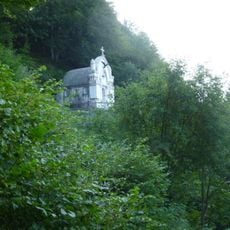
Holy Spirit Church, Javorca, Memorial church in Zatolmin, Slovenia
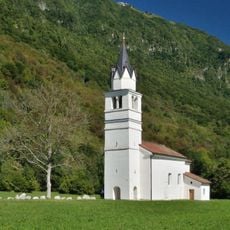
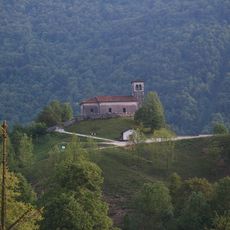
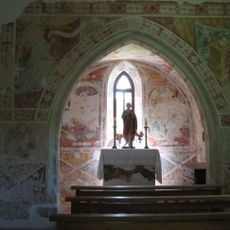
The Holy Spirit Church stands on a stone base reached by a stone stairway, with a wooden upper structure and a bell tower that carries a sundial. Its exterior facade bears 20 coats of arms, including the joint arms of Austria-Hungary with the motto "indivisibiliter ac inseparabiliter". Inside, wooden panels and walls hold the names of 2,808 fallen soldiers.
Built between 1 March and 1 November 1916 by volunteers of the Austro-Hungarian 3rd Mountain Brigade, the church was designed by Vienna architect Remigius Geyling and led on site by Geza Jablonsky. It was consecrated on 1 November 1916 and declared a Slovenian cultural monument of national significance in 1999.
The facade carries 20 coats of arms: the 18 crown lands of Austria-Hungary plus the cities of Trieste and Pula. The gable shows the joint Austro-Hungarian arms with the Latin motto "indivisibiliter ac inseparabiliter" (indivisible and inseparable). The church stands on the Walk of Peace linking First World War relics in the Isonzo valley.
The road to the church leaves Tolmin via Zatolmin and climbs about 8 km along an old Austro-Hungarian supply road to the Polog alpine pasture; it is narrow and partly gravel, with passing bays and new barriers on the valley side. From Polog a steep footpath of about 25 minutes, mostly on concrete, leads to the church, which stands on a base reached by a stone stairway.
The Latin inscription over the entrance reads "Ultra cineres hostium ira non superest" — hatred does not reach beyond the ashes of the dead. The church was raised in 1916 by soldiers of the Austro-Hungarian 3rd Mountain Brigade, including craftsmen from across the empire, and its architect Remigius Geyling had been a friend of Gustav Klimt in Vienna.
The community of curious travelers
AroundUs brings together thousands of curated places, local tips, and hidden gems, enriched daily by 93,175 contributors worldwide.