Plymouth Rock, Glacial boulder in Plymouth, Massachusetts, United States.
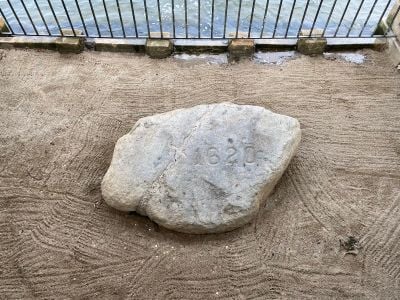
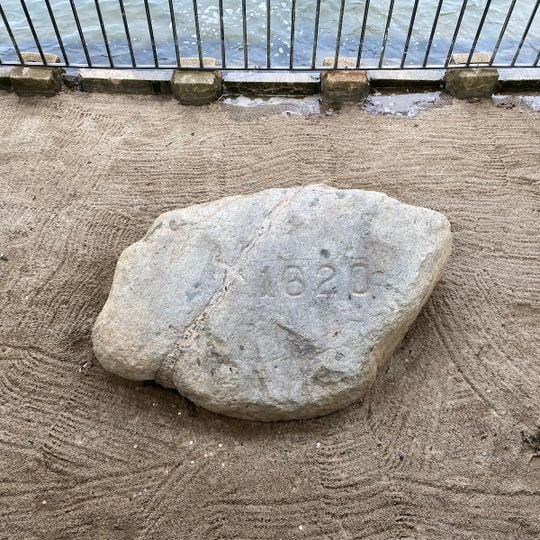
Plymouth Rock is a granodiorite erratic boulder at the foot of Cole's Hill on the Plymouth Harbor shoreline, now set at water level beneath a granite portico designed by McKim, Mead & White. A diagonal crack divides the grey stone, and the date 1620 is carved into its upper right face. Loose sand lies on the ground below and to the left of the boulder.
In 1741, Thomas Faunce first identified this stone as the landing spot of the Pilgrims, based on his father's accounts. Since then, the rock has been moved several times and was eventually returned to its original location near the water.
Families and school groups visit year-round, and many travelers pause to photograph the stone, which serves as a symbol of new beginnings. The site often becomes a starting point for conversations about early settlement and its impact on the indigenous people who lived here.
Access is from Water Street, and the site remains open from April through November, with guided programs during summer months. Visitors should wear comfortable shoes, as the harbor setting can be windy and the ground occasionally damp.
A 40-pound fragment of the rock sits on a pedestal in the cloister of Plymouth Church of the Pilgrims in Brooklyn Heights, New York, and other pieces are held by Pilgrim Hall Museum and the Smithsonian. About a third of the original 20,000-pound boulder survives.
The community of curious travelers
AroundUs brings together thousands of curated places, local tips, and hidden gems, enriched daily by 92,182 contributors worldwide.