Numantia, Archaeological site in Garray, Spain.
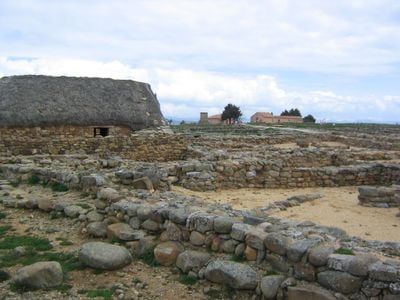
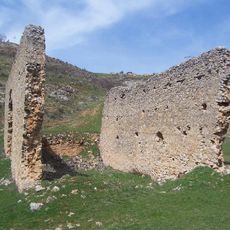
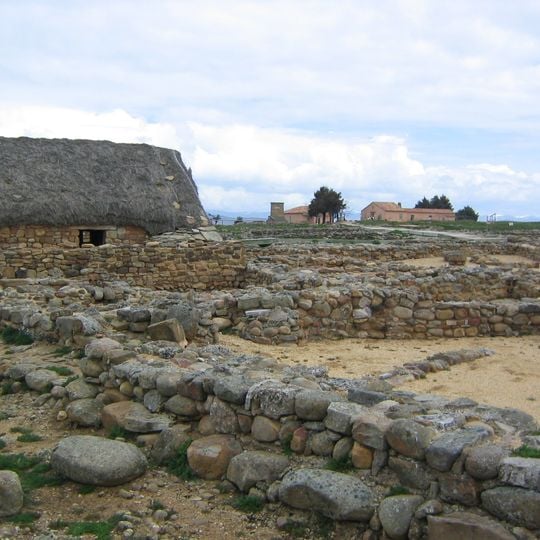
Numantia is a Celtiberian hillfort on the Cerro de la Muela in Garray, Soria, covering up to 8 hectares above the Duero and Merdancho rivers. Its excavated remains include low walls of rough grey and brown stone blocks outlining rectangular spaces, with rounded boulders set among them. A long building with a thick thatched roof of dried grey-brown straw stands in the upper left, its low stone walls pierced by a small dark rectangular opening.
Numantia was an Iron Age hillfort controlling a crossing of the Duero. In 153 BC it took in fugitives from Segeda and defeated a Roman army under Quintus Fulvius Nobilior. Scipio Aemilianus besieged it in 134 BC with 30,000 soldiers and a 9 km ring of towers and moats; after 13 months the inhabitants burned the town and chose suicide over slavery in 133 BC. Occupation resumed in the 1st century BC with a regular street plan but no great public buildings, and decay set in during the 3rd century.
The horse on the copper fibula found at Numantia, a symbol of the goddess Epona and of prestige, is now the emblem of Soria province and appears as a sticker on cars across Spain. Cervantes set his play El cerco de Numancia on the siege, and the term "numantine resistance" is still used for stubborn defiance.
The site sits about seven kilometers (four miles) north of Soria on an exposed hilltop that can be windy and cool even in summer. Visitors should wear sturdy shoes as the paths cross uneven ground and exposed stone ruins.
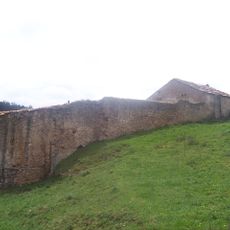
Archaeologists found remains of a double wall ring that surrounded the town and shows its defensive role against multiple attacks. Some houses contained clay storage vessels with traces of charred grain still inside them.
The community of curious travelers
AroundUs brings together thousands of curated places, local tips, and hidden gems, enriched daily by 94,245 contributors worldwide.