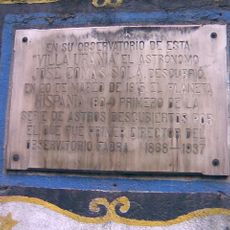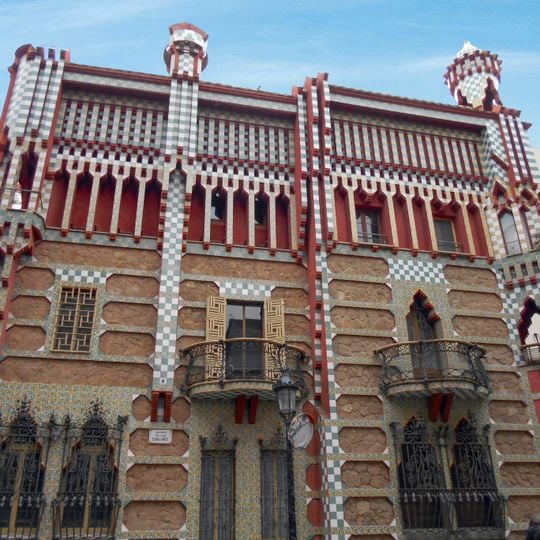
Casa Vicens, House museum in Vila de Gràcia, Spain
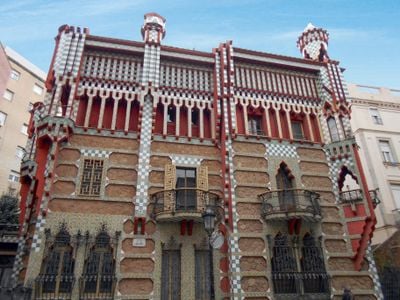
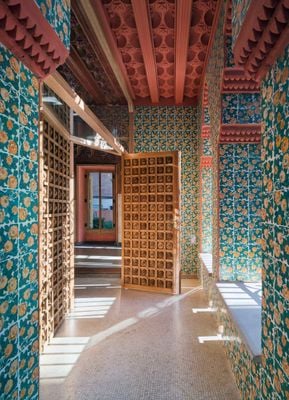
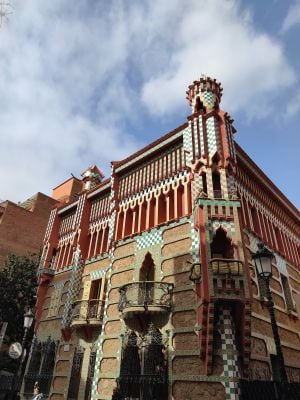
Casa Vicens is a residence with brick walls decorated in yellow and green ceramic tiles, palm motifs, and three facades featuring Moorish-style arches. The building spans three floors plus a basement level with rooms displaying elements from the late 19th century.
In 1883 the wealthy factory owner Manuel Vicens hired young architect Antoni Gaudí to design this summer house, marking Gaudí's first major commission in Barcelona. The project already showed the architect's willingness to experiment with color and shape that would define his entire career.
The house displays the fingerprints of local craftspeople, especially visible in the elaborate ceramic tiles and decorative patterns throughout its rooms. This work emerged from a dialogue between Moorish forms and Catalan traditions of tile-making that visitors can see in every corner.
The house can be comfortably explored on foot through multiple floors connected by stairs, and visitors can choose between guided tours or self-guided walks. Sturdy shoes help since there are many steps and different levels to navigate.
Yellow flowers that grew on the original site inspired Gaudí when designing the signature colors of the ceramic work. This botanical influence shows how the architect wove his surroundings into his artistic vision.
Location: Vila de Gràcia
Architects: Antoni Gaudí
Architectural style: Moorish Revival architecture, Catalan modernism, Art Nouveau architecture
Floors above the ground: 5
Floors below the ground: 1
Accessibility: Wheelchair accessible
Made from material: brick, ceramic glaze
Part of: Works of Antoni Gaudí, list of Modernista buildings in Barcelona
Address: Carrer de les Carolines, 18-24
Opening Hours: Holidays,Monday-Sunday 10:00-20:00; December 25,January 01,06 off
Phone: +34935475980
Website: https://casavicens.org/it
GPS coordinates: 41.40349,2.15064
Latest update: December 6, 2025 16:00
Architecture does not have to follow straight lines and right angles. This collection presents buildings that stand out through their form: domes, spirals, tilted facades or organic structures that recall animals or plants. From Gaudí's mosaic covered works in Barcelona to the stacked concrete cubes of Habitat 67 in Montreal or the conical trulli of Alberobello, these structures demonstrate alternative approaches to construction. Some emerged from technical necessity, such as the temporary cardboard cathedral in Christchurch after the 2011 earthquake. Others are artistic statements: the Guggenheim Museum in Bilbao with its titanium plates, the Dancing House in Prague or the cubist houses in Rotterdam. In Đà Lạt, the Crazy House transforms tree trunks and caves into habitable spaces, while the Atomium in Brussels represents a magnified iron crystal. These structures attract visitors but also raise questions about function and livability. The Longaberger Basket Building in Ohio takes the form of a seven story basket. The Lotus Temple in New Delhi uses concrete shells to form 27 petals. The Aldar headquarters in Abu Dhabi resembles a circular coin. These buildings expand the definition of what architecture can be.
The neo-Moorish architecture developed in the 19th and early 20th centuries, driven by European interest in oriental forms. This architectural movement combines Western building elements with Moorish decorative motifs: horseshoe arches, carved arabesques, geometric mosaics, and ornate stuccoes. This stylistic synthesis appears in a variety of structures, from places of worship to private residences, theaters, and city fortifications. The collection gathers representative examples from across Europe and beyond. In Marseille, the Alcazar Grand Theatre has displayed a façade decorated with oriental patterns since 1857. The Great Synagogue of Brussels, inaugurated in 1878, demonstrates the adoption of this style in Belgian religious architecture. In Germany, Drachenburg Castle near Bonn incorporates Moorish elements into a late 19th-century villa. The movement also reaches unexpected locations: Brighton’s Royal Pavilion blends Indian and Islamic influences for a British royal seaside residence, while rural farms in Hälsingland, Sweden, include ornaments inspired by this orientalist trend. From Pena Palace overlooking Sintra to the Justo Sierra Synagogue in Mexico city, these buildings exemplify the international spread of an architectural style that profoundly marked its period.
Antoni Gaudí shaped Barcelona's cityscape with his modernist buildings that combine organic forms, natural motifs and structural innovations. His work spans more than four decades and includes residential buildings, parks, churches and experimental structures. The Sagrada Família, his monumental basilica under construction since 1882, demonstrates his understanding of geometry and light. Casa Batlló and Casa Milà show his ability to transform facades into sculptural surfaces, while Park Güell implements his vision of architecture within nature. Beyond Barcelona, projects like El Capricho in Comillas and the crypt at Colònia Güell in Santa Coloma de Cervelló demonstrate Gaudí's influence across Catalonia. His early works, including Casa Vicens and Palau Güell, document his evolution from traditional historicism to his characteristic style. The Gaudí House Museum in Park Güell provides insight into his life and working methods. These buildings are distributed throughout the city and mostly accessible to visitors, though some remain residential or operational.
Barcelona offers a wide range of architectural and cultural sites that reflect centuries of Catalan history. The city combines Gothic churches and medieval streets with the organic forms of Antoni Gaudí's modernist buildings. From the Sagrada Família to Parc Güell, his designs shape the cityscape, while the Gothic Quarter and palaces such as Palau Güell represent earlier periods. Museums including the Picasso Museum and Joan Miró Foundation illustrate the city's artistic legacy. Markets like La Boqueria and Sant Antoni provide insight into Catalan daily life. The waterfront district of La Barceloneta, the Olympic Port, and Montjuïc with its cable car and fountain broaden the range. Other destinations include Casa Batlló, Casa Milà, the Hospital de Sant Pau, the National Art Museum of Catalonia, and the Aquarium.
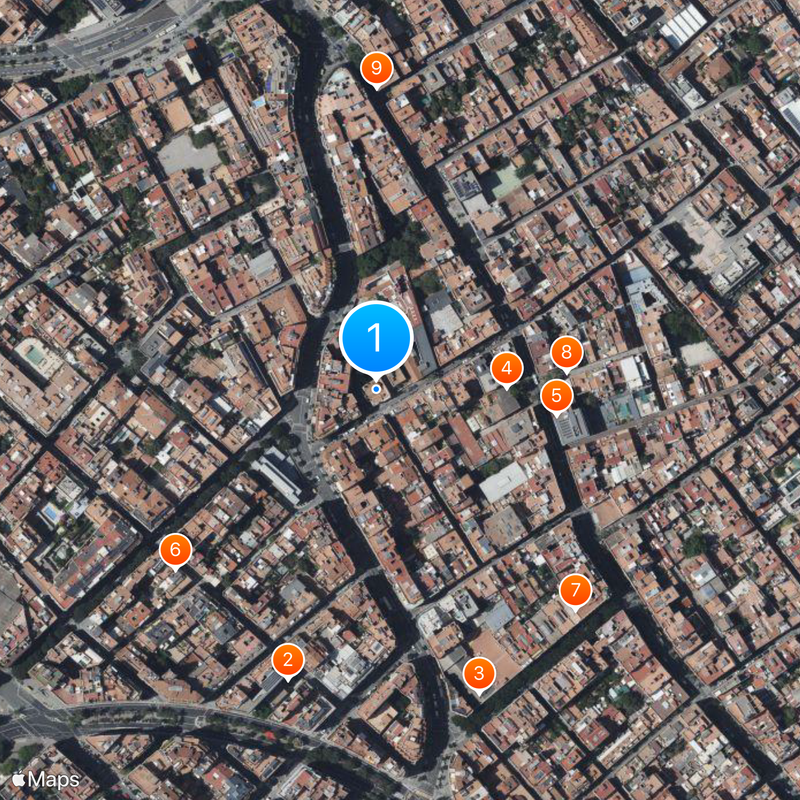
Cases Ramos
302 m
Vil·la Urània
236 m
Cinema Bosque
250 m
Can Trilla
102 m
Youth Council of Barcelona
143 m
Casa-estudi Antoni Tàpies
210 m
Conjunt d'habitatges plurifamiliars a la Rambla del Prat
231 m
A les Colles de Sant Medir
149 m
Cases Antoni Par
235 m
Building in carrer Gran de Gràcia, 125
290 m
Església i Convent de Betlem
179 m
Building in carrer Gran de Gràcia, 133
253 m
Building in carrer Gran de Gràcia, 221-223
153 m
Casa Jacint Bofill Santacana
249 m
Building in carrer Gran de Gràcia, 233
190 m
Casa F. Homet
150 m
Building in carrer Gran de Gràcia, 160
239 m
Building in carrer Gran de Gràcia, 135
241 m
Building in plaça Trilla, 6
126 m
Building in carrer Gran de Gràcia, 137
217 m
Building in carrer de Santa Magdalena, 3
160 m
Casa Illescas del carrer de Lincoln
303 m
Building in carrer Gran de Gràcia, 194
137 m
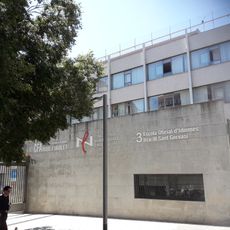
Biblioteca de la Escuela oficial de Idiomas de Barcelona III - Sant Gervasi
88 m
The Over
311 m
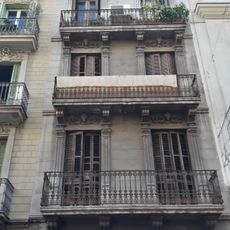
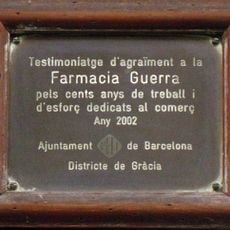
Farmàcia Guerra
215 m
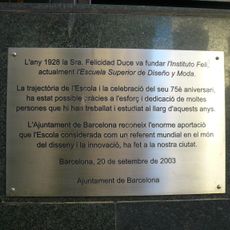
Felicidad Duce
288 m
Mitgera Gran de Gràcia
255 mVisited this place? Tap the stars to rate it and share your experience / photos with the community! Try now! You can cancel it anytime.
Discover hidden gems everywhere you go!
From secret cafés to breathtaking viewpoints, skip the crowded tourist spots and find places that match your style. Our app makes it easy with voice search, smart filtering, route optimization, and insider tips from travelers worldwide. Download now for the complete mobile experience.
A unique approach to discovering new places❞
— Le Figaro
All the places worth exploring❞
— France Info
A tailor-made excursion in just a few clicks❞
— 20 Minutes