Mikeldi idol, Iron Age zoomorphic sculpture at Euskal Museoa, Spain
The Mikeldi Idol is a stone carving that depicts a male hog with a disc beneath its belly, standing about 1.64 meters tall. The figure was shaped from local sandstone and now resides in the Euskal Museoa in Bilbao, where it is carefully preserved and displayed for visitors to examine.
The sandstone boar was carved in the second Iron Age, between the 5th and 1st centuries BC, by an Indo-European culture. Gonzalo de Otalora first described it in 1634, noting worn inscriptions on the disc. In 1864 Juan Ernesto Delmas and Antonio de Trueba found it fallen and half-buried; the landowner Saturnia de Isusi had it reburied. It was unearthed for good in 1896 and moved to the cloister of the Bilbao museum in 1921.
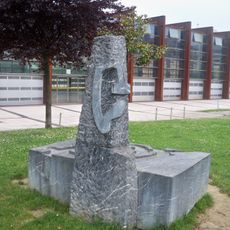
The name comes from the San Vicente de Miqueldi chapel beside which it was found; the chapel was demolished in 1950 by Mikeldi S.A., the company later named after the idol. In 1623 Tabira's council debated removing a bull with a globe beneath it from its coat of arms, an image recorded some 24 years after the traditional arms were changed. A stone reproduction made around 1970 stands on Mikeldi street in Durango, near the find site.
The original is held in Bilbao's Museo Arqueológico, Etnográfico e Histórico Vasco, where it has been on public view in the cloister since 1921. It is on deposit, not owned by the museum, so its return to Durango has been discussed since a 2016 council motion without resolution. A stone copy made around 1970 stands in Durango on Mikeldi street, near the find spot.
In 1634 Gonzalo de Otalora recorded engraved characters on the disc, calling them "notable and not understood"; by 1769 Enrique Flórez found no trace of them. A 2013 laser scan confirmed traces of the carvings, and the disc remains the only one known on any verraco.
The community of curious travelers
AroundUs brings together thousands of curated places, local tips, and hidden gems, enriched daily by 93,779 contributors worldwide.