Roman Bridge of Talamanca de Jarama, Medieval stone bridge in Talamanca de Jarama, Spain
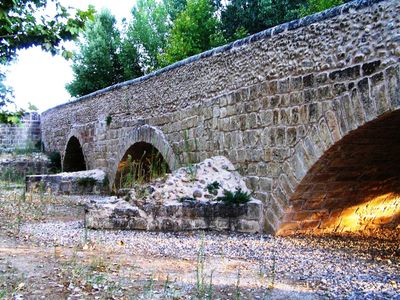
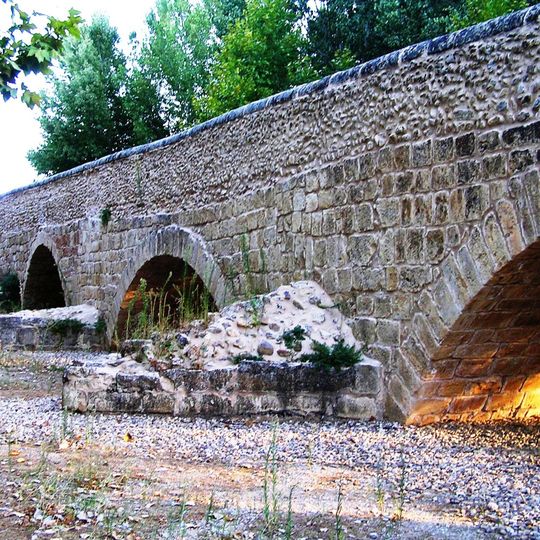
The Roman Bridge of Talamanca de Jarama stands north–south on the outskirts of the village, no longer spanning the Jarama, whose course shifted east. It has five uneven arches: the southernmost spans 17.9 m with a 6 m rise, while the other four measure 7.9–8.6 m wide and 2.45–3.25 m high. Limestone ashlar forms the arches, spandrels and cutwaters, with cobblestone masonry above and at the approaches; all cutwaters are triangular except the first on the south, which is trapezoidal.
The bridge is Roman in origin, according to petrological studies, but its present form results from medieval and 16th-century rebuilding. The Archdiocese of Toledo, which held jurisdiction over Talamanca from 1091, carried out documented repairs, and a commemorative inscription on the main arch records 16th-century work. Between the 9th and 10th centuries it served a defensive role in the Islamic Marca Media, likely rebuilt to link fortifications between Talamanca and the Tiétar valley. After the Christian conquest it became a toll bridge on the route to Toledo.
Some of the limestone blocks carry mason's marks: 265 have been counted on the roadway, cutwaters and arch voussoirs, plus 29 on the reinforcement of the right bank. Crosses, angles, six-pointed stars and arrows recur, cut in thick strokes by the stonemasons' guild.
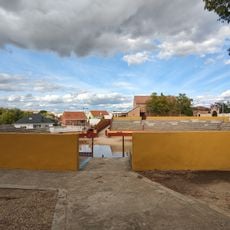
The location sits about ten minutes walk from the historic center within a green area shaded by poplar trees. The flat riverbank allows easy access from both sides of the structure.
The bridge was listed as a Bien de Interés Cultural in 1996 under the name Puente Sobre El Arroyo del Caz, not its Roman name. Its 265 mason's marks, cut into the ashlar, abutments and arch voussoirs, include crosses, six-pointed stars and arrows left by medieval quarrymen.
The community of curious travelers
AroundUs brings together thousands of curated places, local tips, and hidden gems, enriched daily by 95,446 contributors worldwide.