Nueva Square, Main square in Vitoria-Gasteiz, Spain
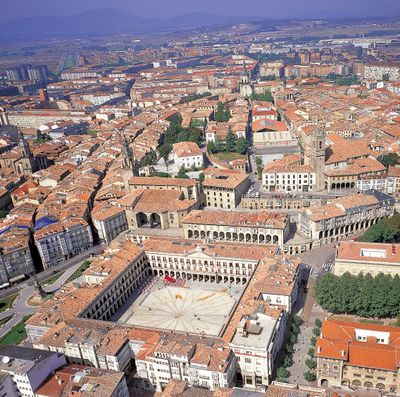
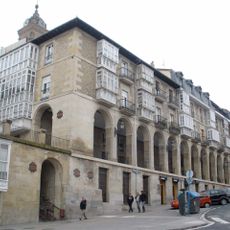
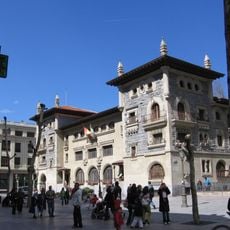
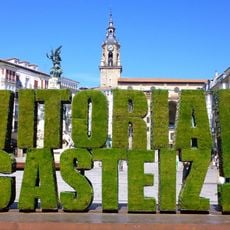
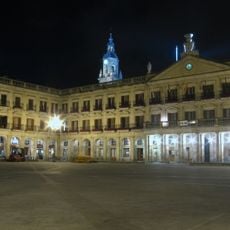
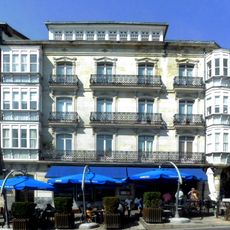
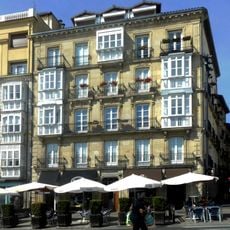
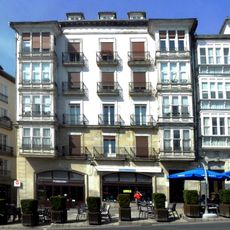
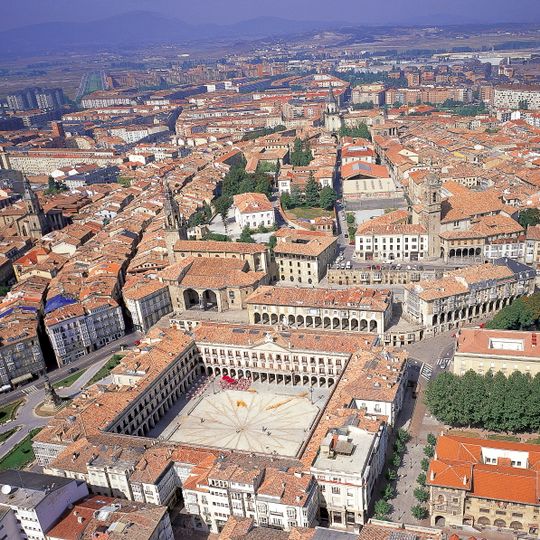
Plaza de España, also called Plaza Nueva, is a neoclassical square in central Vitoria-Gasteiz forming a perfect 61-metre square. The north wing holds the city hall, whose facade ends in a balustrade with urns, a large pediment and the city coat of arms carved in stone; the south, east and west sides are open. Round-headed arcades on pilasters, replaced by columns at the entrances, run around the base, mixing ashlar stone, rubble masonry and brick.
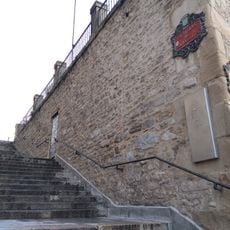
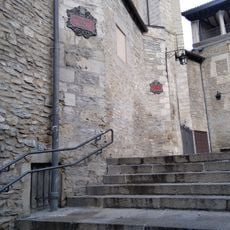
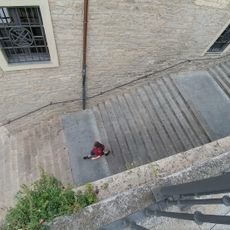
On 15 March 1780 the mayor, Ramón María de Urbina, proposed a new square to link the old town with the ensanche and fix the site of the town hall. Construction began on 17 October 1781, the city's 600th anniversary, to plans by Justo Antonio de Olaguíbel; the square opened in 1791, and the council first met there on 24 December 1791. Levelling a 20-metre slope was solved by building Los Arquillos. It was listed as a Spanish monument in 1984.
The square's name changed with each political era: Plaza Nueva in 1791, Plaza de la Constitución around 1820, Plaza de Alfonso XIII in 1927, Plaza de la República in 1931 and Plaza de España from 26 August 1936. Every Sunday it hosts a collectors' market for coins, stamps and postcards, and on the Thursday before Christmas Eve an agricultural and craft market.
The square is centrally located and easily accessible on foot, with ample seating scattered throughout for resting between activities. The covered arcades provide shelter from sun and rain, making it comfortable to spend time here regardless of the season.
The arcades retain original 18th-century details such as decorative columns and stone arches that many visitors overlook while passing through. These architectural elements give the square its particular rhythm and create unexpected pockets of history at different corners.
The community of curious travelers
AroundUs brings together thousands of curated places, local tips, and hidden gems, enriched daily by 94,140 contributors worldwide.