Tremp Formation, Geological formation in Pre-Pyrenees, Spain.
The Tremp Formation is a layered geological sequence in the Pre-Pyrenees of Catalonia, made up of sandstone, conglomerate, shale, marl, and limestone. The layers are exposed at many points across the landscape and can be read clearly by anyone looking at the rock faces.
The formation took shape during the late Cretaceous and early Paleogene, when tectonic forces created basins in the northeastern part of the Iberian Plate. Sediments slowly filled these basins over millions of years, building up the layers that can be seen today.
The museum in Isona displays fossils and bones found in the surrounding rocks, including dinosaur eggs and marine animal remains. Driving through the region, visitors can clearly see the stacked rock layers on cliff faces, each one representing a different period in Earth's history.
The exposed rock layers can be seen at several outdoor locations, and the area is best visited on foot or by car. Some sections sit on slopes, so sturdy footwear is a good idea before heading out.
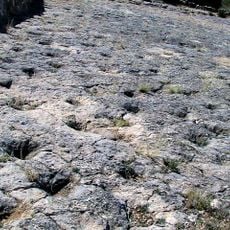
The formation's dinosaur tracks reach to within 300,000 years of the Cretaceous-Paleogene boundary, and its nesting sites lie in situ across an area of 6,000 square metres. Since 2004 there have been proposals to protect the formation as a geological site of interest, and in 2018 UNESCO designated the Conca de Tremp-Montsec area a Global Geopark.
The community of curious travelers
AroundUs brings together thousands of curated places, local tips, and hidden gems, enriched daily by 94,818 contributors worldwide.