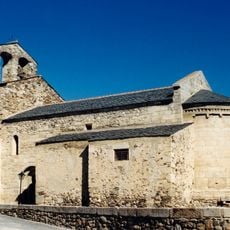
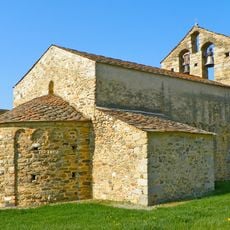
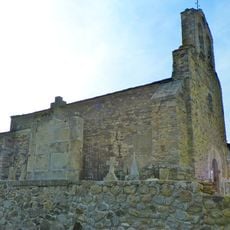
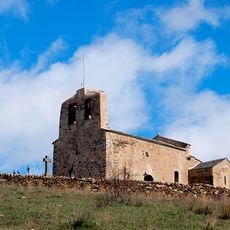
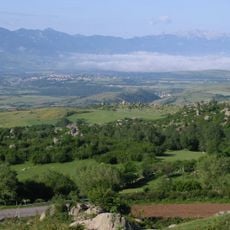
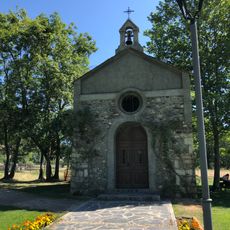
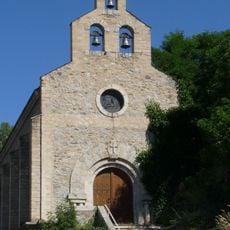
Mare de Déu dels Àngels de Llívia, Catholic church in Llívia, Spain
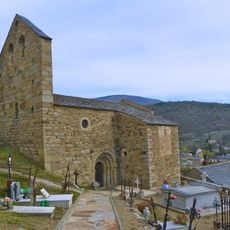
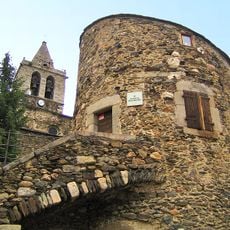
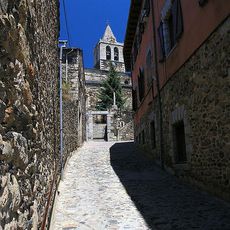
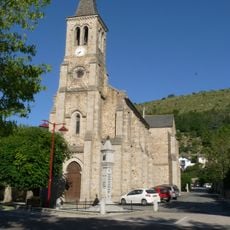
Mare de Déu dels Àngels is a church built in the late 16th and early 17th centuries, completed in 1617. It has a single nave with a polygonal apse, five lateral chapels on each side, and a Renaissance portal with columns, niches and a pediment. Two round defence towers with loopholes flank the smooth façade, giving it a fortified look.
The church was built in the late 16th century and finished in 1617, replacing a 1277 church and reusing its materials. It rose in the new town centre below Puig del Castell after the 15th-century devastation. The castle above had been blown up by Louis XI of France in 1479 after a siege of more than 14 months; the round defence towers were added after its destruction.
Thirteen carved slabs lie along the central aisle, spanning the 15th to 19th centuries and naming old Llívia families such as Carbonell, Salses, Arròs, Palau and Jordana. At least ten more are set between the south door steps and the streets Forns and Baixada de l'Església. M. Vilaseca i Narbona studied each slab in the 1989 ninth Quadern d'Informació Municipal.
The location in the center of Llívia's old town makes walking the most convenient way to explore the area. Access to the interior may be limited outside service times, so timing your visit around regular services works best.
The organ, built in Collbató, stands in the fifth chapel on the south side and follows the Catalan layout, with the largest pipes at the sides rather than the centre as in Castilian organs. It has 1,154 sounding pipes, 45 canister pipes and mechanical transmission, and its cornet stop is noted for chorales and solo themes.
The community of curious travelers
AroundUs brings together thousands of curated places, local tips, and hidden gems, enriched daily by 94,218 contributors worldwide.