Sant Pere de Camprodon, Benedictine monastery church in Camprodon, Spain
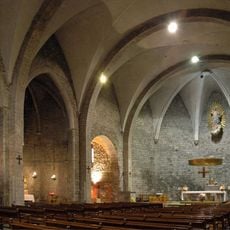
Sant Pere de Camprodon is a Romanesque church built in the mid-12th century and consecrated in 1169, the only surviving part of a Benedictine monastery. It has a Latin cross plan with five square apses, the largest as wide as the nave, and a pointed barrel vault reinforced by transverse arches. Above the crossing an octagonal lantern crowns a two-storey bell tower; the portal is its only carved ornament.
A church dedicated to Saint Peter was consecrated in 904 by Bishop Servus Dei of Girona. Around 950 Count Guifré II of Besalú established a Benedictine monastery there, which was affiliated with Moissac, a Cluny dependency, from 1078 to 1461. Monastic life ended with the exclaustration of 1835, and the ruined monastic buildings were demolished in 1932.
The church interior holds tombs of former abbots, while the diocesan museum in Girona preserves original capitals from the old cloister. These remains reflect the monastic community that shaped this place for centuries.
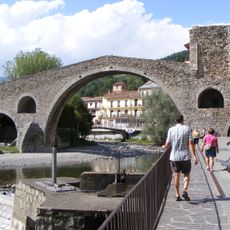
The church stands in the centre of Camprodon, in the Ripollès comarca. Only the church survives; the monastic buildings were demolished in 1932 after the 1928–32 restoration directed by Jeroni Martorell. Look for the restored porch with its columns and capitals, and note that the cloister capitals are now kept in the diocesan museum of Girona.
The church has five square apses, not four: the largest is as wide as the nave, and two open on each side of the transept. The cloister capitals that survived the 1428 earthquake are now kept in the diocesan museum of Girona.
The community of curious travelers
AroundUs brings together thousands of curated places, local tips, and hidden gems, enriched daily by 93,811 contributors worldwide.