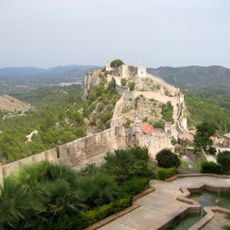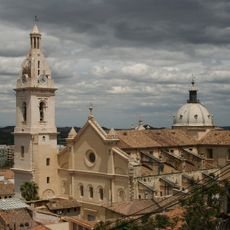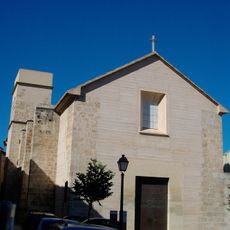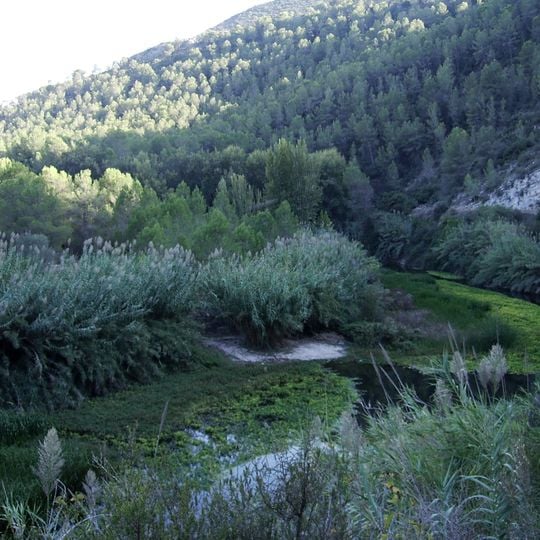
La Cova Negra, Archaeological cave in Xàtiva, Spain.
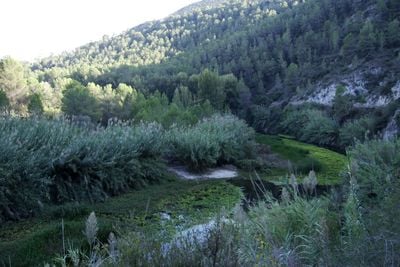
La Cova Negra is a cave in a narrow gorge cut by the Albaida river through the Serra Grossa, near Xàtiva. Its walls look blackish, which gives the site its name. The cave lies in a broad meander below the Paller peak, within a 57.18-hectare municipal natural area.
The site was discovered in 1933 by the priest G. Viñes. In 1981 it was declared a historical-artistic and archaeological monument, and in 2006 a municipal natural site. Excavations led by Valentín Villaverde of the University of Valencia uncovered Neanderthal fossils, including children's remains, and Mousterian flint tools. A 2019 study dated the occupation to between 273,000 and 146,000 years ago.
The cave's name comes from the dark colour of its walls. Excavations directed by Valentín Villaverde of the University of Valencia found Mousterian flint tools and 247 bird remains of 18 species, mainly doves and choughs, showing that Neanderthals hunted small, fast game.
The cave lies in the narrow Albaida river valley at the exit of the Estret de les Aigües, below the Paller peak, and is reached on foot along the river path that runs through the 57-hectare natural site. The path offers the clearest view of the cave walls and the contrast between riverbank and mountain vegetation. Access to the archaeological deposit itself is restricted as a protected heritage site, so check locally before setting out.
The cave walls look black, which gave the site its name. Excavations led by Valentín Villaverde of the University of Valencia found fossil remains of Neanderthal children, including an intact femur and radius, suggesting deliberate burials. Cut marks on bones may point to cannibalism or rituals.
The community of curious travelers
AroundUs brings together thousands of curated places, local tips, and hidden gems, enriched daily by 94,018 contributors worldwide.