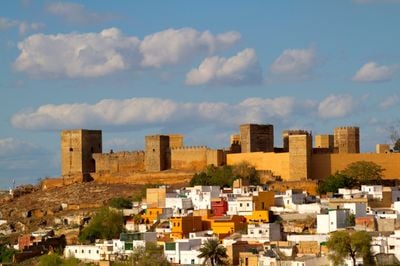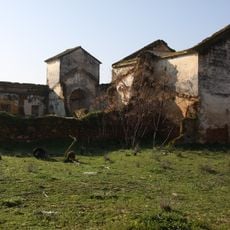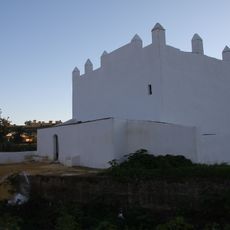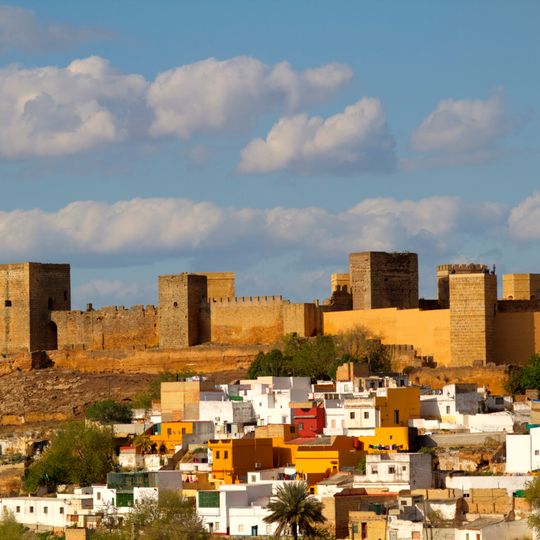
Castillo, Medieval castle in Alcalá de Guadaíra, Spain.
The Castillo is a fortress complex positioned on a hill above the Guadaíra River, featuring eleven interconnected towers surrounded by fortified walls. The layout combines various defensive structures and shows how the fortification evolved across different periods.
The fortified complex began with an Iberian settlement and was largely fortified in the second half of the 12th and first third of the 13th century under Almohad rule, with works linked to Abu Yaqub Yusuf around 1162 and 1172. The core of the present castle was built from the Castilian conquest of Alcalá in 1246 to the mid-14th century, when it served as Seville's defensive outpost against the Kingdom of Granada. Its last major upgrade came between 1471 and 1477 under Rodrigo Ponce de León, Marquis of Cádiz, who used it as a base against Seville and Jerez.
The name Alcalá derives from the Arabic al-qal'a, "the fortress", a reminder that the town grew around this enclosure. The site is a Bien de Interés Cultural since 4 April 1924. Visitors cross the esplanade of the vanished medieval town to reach the castle itself, passing the Torre Mocha and the corachas of San Miguel.
The site is within walking distance of the town center and can be explored without special equipment. Some paths inside are uneven and shade is limited, especially during hot hours.
The castle's three inner enclosures are linked by a bent passage, not by tunnels: the Patio de la Sima, with six towers, opens into the Patio de los Silos through a dog-leg gate. The Silos courtyard keeps excavated remains of stairs to the adarve, stables and kitchens, and the western enclosure held palatial residences behind a moat.
The community of curious travelers
AroundUs brings together thousands of curated places, local tips, and hidden gems, enriched daily by 93,478 contributors worldwide.