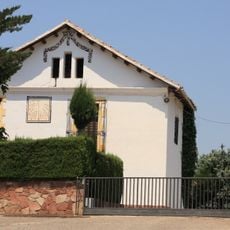
Santa Maria de Cervelló, Romanesque church in Cervelló, Spain
Santa Maria de Cervelló is an 11th-century Romanesque church in Cervelló, in the Baix Llobregat, beneath the ruins of Cervelló Castle. It has a single nave with a barrel vault on two transverse arches, a semicircular apse with three windowed niches, and an octagonal dome on squinches over the first bay. Two lateral chapels added in the 16th century form a transept.
First documented in 904 when Wifredo II of Barcelona donated it to the Monastery of Sant Cugat, the church was originally dedicated to the Holy Cross. After lying dormant when a new parish church was built in 1872, it reopened for worship in 1922 with its present name.
The church is now known as Santa Maria de Cervelló, after the Barcelona saint beatified in 1692, to whom a Baroque side chapel was dedicated. The 1587 Renaissance portal, by the Occitan master builder Lleonard Bosc, shows the Eternal Father with a triangular halo blessing and holding an orb. Anthropomorphic medieval tombs remain in the former parish cemetery around the temple.
The church stands under the ruins of Cervelló Castle, south of the old town centre, over 1 km uphill from the village; there was no bridge over the stream, which contributed to its abandonment in 1872. The site is reached on foot from the town. The former rectory at the foot of the church was sold in 1880 and became Mas Pitarra.
The bell tower stood on the octagonal dome, not beside it, and was demolished in 1968 during restoration work. The dome itself rises on squinches over the first bay of the nave, an unusual height for a single-nave church. Anthropomorphic medieval tombs and possible hermit caves lie around the building.
The community of curious travelers
AroundUs brings together thousands of curated places, local tips, and hidden gems, enriched daily by 95,142 contributors worldwide.