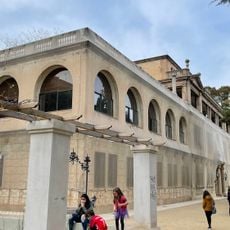
Parc del Guinardó, Municipal park in Horta-Guinardó district, Barcelona, Spain
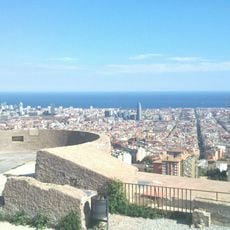
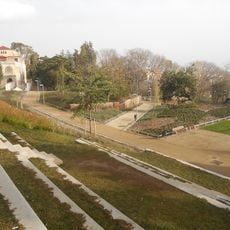
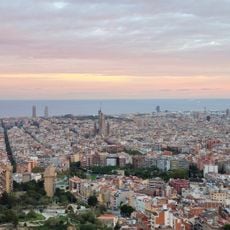
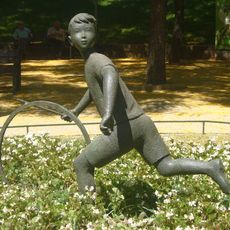
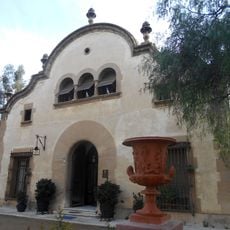
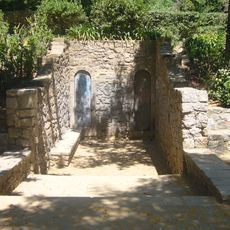
Parc del Guinardó covers about 16 hectares on the Guinardó hill, one of the foothills of the Collserola range above Barcelona. Its main entrance at Plaça de Puig i Alfonso opens onto broad terraces at different levels, separated by slopes with shrubs and grass. Above them, a safareig or washing basin releases water down stone channels into small pools, and the upper part is a pine wood on steep slopes around the amphitheatre-like Mitja Lluna.
The designed gardens were created in 1918 by Jean-Claude Nicolas Forestier and Nicolau M. Rubió i Tudurí and display Noucentisme architectural style. This design approach shaped the park's layout with water elements and geometric structures typical of that era.
The name Guinardó comes from Mas Guinardó, a former house where writer Miguel de Cervantes reportedly stayed during his travels through Catalonia. This historical connection links the place to the region's literary past.
The park offers multiple entrances at different elevation levels, allowing visitors to explore flexibly. The paths are accessible on foot and partially by bicycle, with varying difficulty levels depending on which route you choose.
On the upper slope of the park lies one of the most important Iberian sites of the Barcelona plain, excavated by Joan Colomines in 1931. He found a rock-cut wall with two access paths, a round defensive tower at the entrance gate, three silos, loom weights and handmade Campanian-style pottery, dating the site to the 3rd–2nd centuries BC.
The community of curious travelers
AroundUs brings together thousands of curated places, local tips, and hidden gems, enriched daily by 94,848 contributors worldwide.