Portal del Bisbe, Roman city gate in the Gothic Quarter, Barcelona, Spain
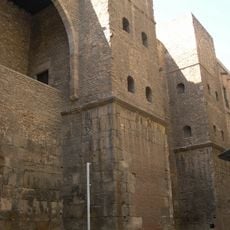
Portal del Bisbe is the only surviving gate of the four that opened in Barcelona's Roman wall. It stands at the entrance to Carrer del Bisbe, facing Plaça Nova. Of the original three passages—a wider central one for carts and two side ones for pedestrians—only one side passage remains, flanked by two semicylindrical towers. The right tower adjoins the Palau Episcopal; the left tower adjoins the Casa de l'Ardiaca, built over the old wall.
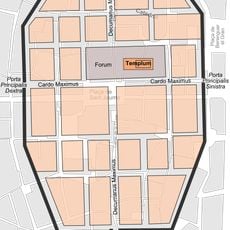
In Roman times this was the Porta Praetoria, the gate through which the decumanus entered the colony of Barcino; the street of the Bishop still follows that line. The two semicircular towers belonged to the cathedral archdeacons and were heightened in the 12th century, and windows were opened in the 16th. The Generalitat built an arch linking the towers in 1614, destroyed in 1823, and the gate's present appearance dates from between 1883 and 1895.
The gate is named after the bishop because the right tower abuts the Palau Episcopal, while the left tower belongs to the Casa de l'Ardiaca, built over the Roman wall. In the 12th century both towers were owned by the archdeacons of the cathedral, who raised their height. Look for the 16th-century niche with a Saint Roch image beside the 1958 arcade.
The gate stands at the mouth of Carrer del Bisbe, facing Plaça Nova, and the surviving left tower is attached to the Casa de l'Ardiaca, whose façade on Avinguda de la Catedral shows the wall it was built on. The right tower abuts the Palau Episcopal. Look low on the left tower for the 1958 arcade recreating a Roman aqueduct section, with a 16th-century image of Saint Roch in a niche beside it.
The left tower hides the castellum aquae, the Roman reservoir where both aqueducts bringing water to Barcino converged; it survives inside the Casa de l'Ardiaca, today the city's Historical Archive. The low arcade attached to that tower is not Roman: it was built in 1958 with materials recovered from excavations of the original aqueducts, and beside it stands a 16th-century niche with an image of Saint Roch.
The community of curious travelers
AroundUs brings together thousands of curated places, local tips, and hidden gems, enriched daily by 93,562 contributors worldwide.