Old bridge of Lugo, Roman stone bridge in Lugo, Spain
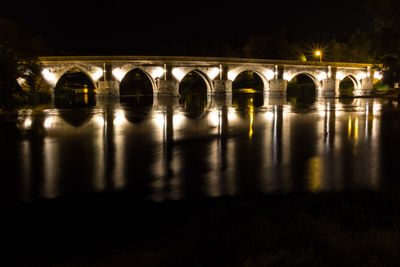
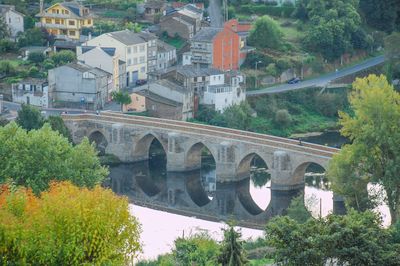
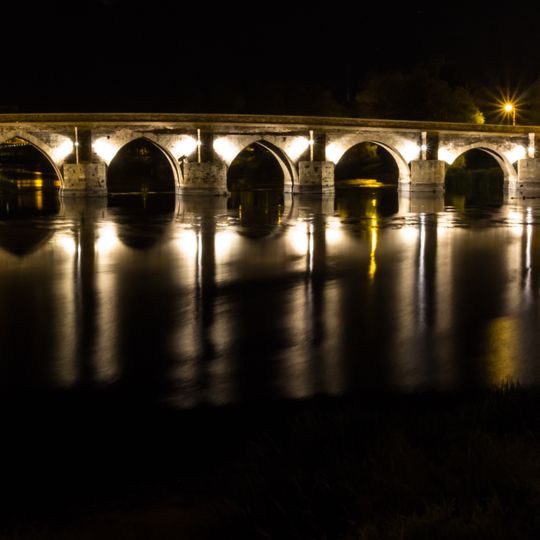
The Roman bridge of Lugo is a stone bridge crossing the Minho River in the city of Lugo, in northwestern Spain. It is about 104 meters long and 4 meters wide, and it is open only to pedestrians.
The bridge has a Roman origin and was built during the Romanization of Galicia, carrying route XIX of the Antonine Itinerary between Lucus Augusti and Bracara Augusta via Iria Flavia. It was rebuilt several times in the 12th, 14th and 18th centuries, and altered in 1893. In 2009 a new bridge diverted traffic, and restoration removed the metal walkways and asphalt; Manuel Durán's study found the lower structure to be purely Roman.
The Calzada da Ponte, the paved way descending from the Puerta Miñá gate of the Roman wall to the bridge, forms part of the Camino Primitivo to Santiago de Compostela; the route begins at that gate, not at the bridge itself. The same street is the trailhead for the Las ribeiras altas hiking route, known as the Paseo del Puente Viejo, which runs over eleven kilometres along both banks of the Miño toward the old light factory.
The bridge is flat and easy to walk across, with no steps or obstacles, making it accessible for most visitors. Footpaths run along both banks of the Minho from either end, so you can extend your walk in either direction after crossing.
The bridge stands a short walk from Lugo's hot springs, which the Spanish source says also date from Roman times. In 2009, when a new bridge took the traffic, the old crossing was restored: the metal walkways and asphalt were removed, and engineer Manuel Durán's survey of the exposed piers found the lower masonry to be purely Roman.
The community of curious travelers
AroundUs brings together thousands of curated places, local tips, and hidden gems, enriched daily by 94,852 contributors worldwide.