House of the Dragons, Eclectic architecture building at Plaza de los Reyes, Spain.
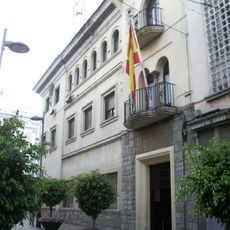
The House of the Dragons stands on the corner of Paseo de Camoens and Calle Millán Astray, facing Plaza de los Reyes. Valencian architect José M. Cortina Pérez gave the building an eclectic design, with a base of artificial stone and four dragons on the roof. The lower facade's green tile cladding was removed in a 1996 restoration by Ignacio García de la Barga Palacios, who installed marble similar to the original.
Commissioned in 1900 by Francisco Cerni González, mayor of Ceuta from 1897 to 1903, and his brother Ricardo, the house was designed by Valencian architect José M. Cortina Pérez and completed in 1905. The Falange Española party had offices here after the 1936 uprising. The building was sold in 1946, and the facade was restored in 1973 and 1996.
The building was meant to bear the name of the Cerni González brothers, but the four bronze dragons on the roof gave it its popular name, echoing the architect's 1901 Building of the Dragons in Valencia. After the 1936 uprising the Spanish Falange party kept its offices here until the house was sold in 1946.
The building stands on the corner of Paseo de Camoens and Calle Millán Astray, on Plaza de los Reyes in central Ceuta. Visitors reach it on foot from the surrounding streets; the dragons sit at roof level, so look up from the square to see them.
The four dragons on the roof are not the originals: those were taken down in 1925 and lost. Local artist Antonio Romero Vallejo, born in 1958, designed the replacements, made largely of resin and fibreglass painted to look like bronze and weighing under 200 kg each; they were installed and formally opened in November 2006. Vallejo also made the bronze Tribute to the Artillery outside the Royal Walls on Avenida Martínez Catena.
The community of curious travelers
AroundUs brings together thousands of curated places, local tips, and hidden gems, enriched daily by 95,459 contributors worldwide.