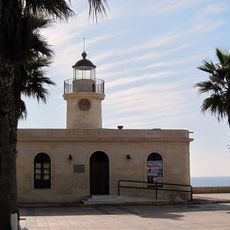
Castillo de Santa Ana, Coastal defense fortress in Roquetas de Mar, Spain.
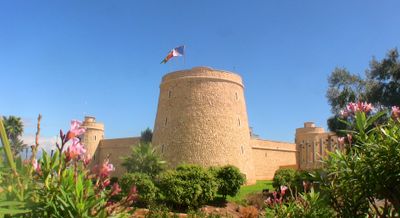
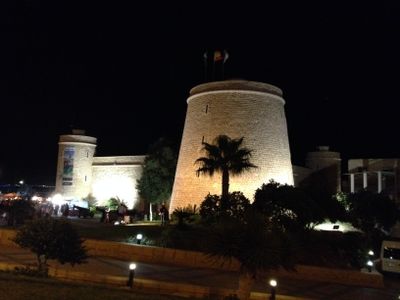
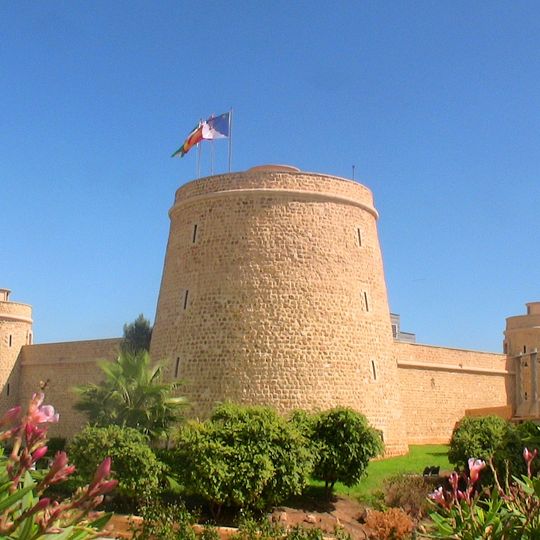
Castillo de Santa Ana is a stone fortification in Roquetas de Mar with an oblong plan, built of light tan rough-cut masonry. Its main cylindrical tower rises to a flat top where three flagpoles stand, and its walls are pierced by narrow vertical slit openings. A lower wall of the same stone connects to adjoining structures, and a smaller round tower rises behind.
A tower stood here from the early 14th century, raised under the Nasrid ruler Yusuf I. In the 16th century a tower was built to guard the salt pans and their shipment, after pirates raided the Almería coast for salt cargoes and captives. Luis de Castro Inestrosa rebuilt the walls, towers and houses in the 17th century and added a new artillery parapet. The 1804 earthquake ruined the interior buildings, leaving the towers and bastion standing.
The fortress now serves as a cultural venue, regularly displaying artworks by local artists and exhibitions focused on regional history. Visitors encounter these exhibitions as they move through the structure.
Entry to the castle is free. The interior is organised over three levels: the courtyard holds the visitor information centre, the first floor the permanent collections, and the keep on the second floor the naval model display, with visitable battlements looking over the sea and the town. The inner courtyard hosts concerts and performances, mainly in summer.
In the 1960s or 1970s, when the castle lay in ruins, local butcher Antonio Fernández Triguero, known as "Richoli", bought it; the sale was later annulled because the monument was state-protected, and part of the sum was refunded. The episode is recorded in the Archivo Histórico Provincial de Almería.
The community of curious travelers
AroundUs brings together thousands of curated places, local tips, and hidden gems, enriched daily by 94,498 contributors worldwide.