Sant Antoni Abat, parish church in Vilanova i la Geltrú, Spain
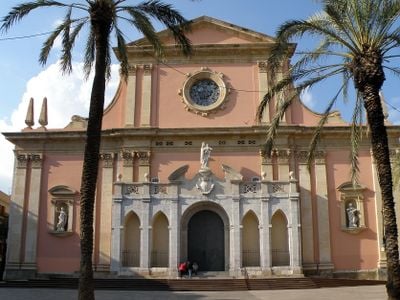
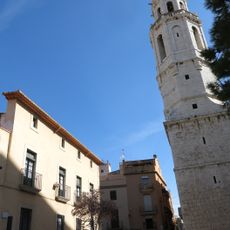
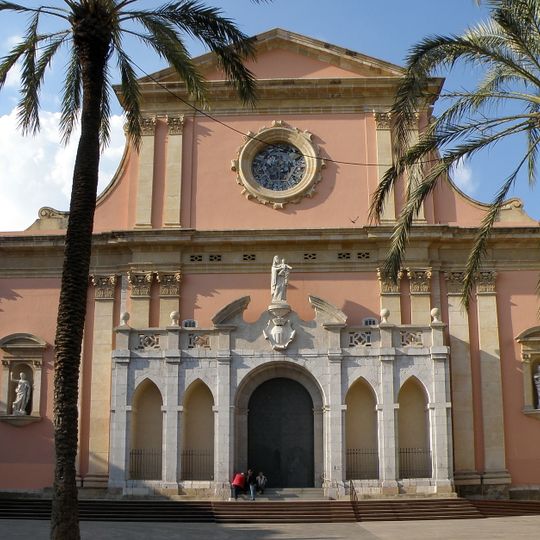
Sant Antoni Abat is a Baroque and Neoclassical parish church with a basilical plan of three naves and side chapels, roofed by a barrel vault over the main nave and ribbed vaults over the lateral ones. It has two façades: the Plaça de Sant Antoni front, with four large composite-capital columns, a plain entablature, a triangular pediment and three round-arched doors, the central one taller, plus a niche holding the image of Saint Anthony; and the Plaça de les Neus front, with a projecting body, ogival and round-arched openings, a single door, a rose window and a triangular pediment. Its bell tower stands apart from the church.
In 1663 the town agreed to replace its 14th-century parish church. Work began with the bell tower (1670-1706), built to a design by Fra Josep de la Concepció and supervised by Joan Homs. The War of the Spanish Succession delayed the church itself until 1734; it was blessed in 1771 while unfinished, resumed in 1790 with the old temple demolished, and the naves were completed and blessed again in 1831. The façade was finished in 1879, heavy damage in 1936 was repaired until 1977, and a new bronze angel was raised on the tower in 1996.
The church is dedicated to Saint Anthony Abbot, and the chapel of music was led by chapel masters Jeroni Parera i Mata, Antoni Oller i Fontanet (1861) and Magí Sans i Bartomeu (1861–1918). The bell tower is topped by a bronze angel, a 1996 replacement for the 2.7-metre copper figure by Joan Pau Coca, based on Miquel Llavina's model, that stood until 1936.
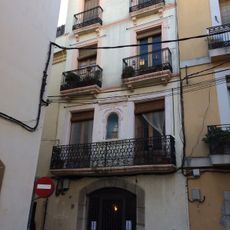
The church has two entrances: the main door on Plaça de Sant Antoni, framed by four large columns, and a second door on Plaça de les Neus, finished in 1977. The bell tower stands apart from the church, so it can be seen from the squares without entering. The building is a protected local cultural asset.
The bell tower stands apart from the church and was built first, between 1670 and 1706, following a design by Fra Josep de la Concepció. Its square base carries a shield dated 1673, and the upper octagonal bodies end in a dome topped by a metal sphere and a bronze angel. The original 2.7-metre copper angel by Joan Pau Coca, modelled by Miquel Llavina, was lost in 1936; a new angel was placed in 1996.
The community of curious travelers
AroundUs brings together thousands of curated places, local tips, and hidden gems, enriched daily by 94,048 contributors worldwide.