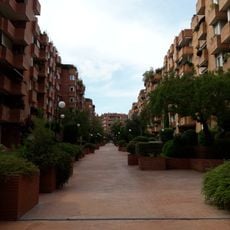
Jardins de Vil·la Amèlia, Urban park in Sarrià, Spain
Jardins de Vil·la Amèlia is an urban park in Barcelona with expansive grounds featuring pathways, seating areas, and diverse open spaces. The park includes a central pond, varied plantings, and facilities for activities such as table tennis and children's play areas.
Ignasi Girona bought the land in 1861–1862 and had a large house built, finished in May 1864 and named Vil·la Amèlia after his wife, Amèlia de Vilanova. In 1968 the city agreed to expropriate 23,900 m² for green space and 5,235 m² for streets from the Fradera family, and Joaquim Maria Casamor remodelled the gardens in 1970, keeping the winding paths and irregular beds.
The pond's central island holds Ricard Sala's bronze Dríade, and near the Washingtonia palm walk stands Jules Anthone's El encantador de serpientes, bought by the city at the 1898 Fine Arts Exhibition. A third nude, Bañándose by Jaume Martrús, was removed after vandalism. The park's name honours Amèlia de Vilanova, wife of Ignasi Girona.
The park is open daily and offers table tennis facilities, children's play areas organized by age group, and designated spaces for dogs. Visitors can explore different zones throughout the grounds and choose areas that suit their interests and needs.
The park's oldest tree is a Eucalyptus globulus listed in Barcelona's Catalogue of Trees of Local Interest. It stands among other century-old trees, including white pines on an earth mound and a row of Washington palms. The palm walk leads to Jules Anthone's 1887 statue The Snake Charmer, bought by the city in 1898.
The community of curious travelers
AroundUs brings together thousands of curated places, local tips, and hidden gems, enriched daily by 93,650 contributors worldwide.