Duana de Barcelona, Neoclassical palace in Sant Pere, Santa Caterina i la Ribera, Barcelona, Spain
The Duana de Barcelona is a free-standing neoclassical building on the Pla de Palau, raised between 1790 and 1792 under Juan Miguel de Roncali. Its rectangular plan measures 85 by 52 varas around a large porticoed central courtyard. The stuccoed facade has a Tuscan ground floor and a Doric upper floor, with three doors framed by paired Tuscan columns on a black marble plinth; the central arch bears a relief mask holding a ring in its mouth.
Built between 1790 and 1792 under Juan Miguel de Roncali, minister of finance of Charles IV, it replaced an earlier customs house destroyed by fire in 1777. In 1802 part of it housed the kings of Etruria during their visit, linked to the Royal Palace by a temporary wooden bridge. It became the civil government headquarters in 1902 and has been closed since 2008.
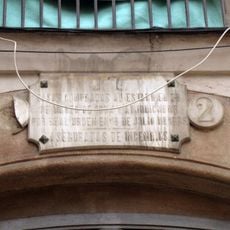
The facade inscription reads "Reinando el señor don Carlos IV, año de 1790", yet the sculptural programme centres on his predecessor Charles III. Frescoes of episodes from Spanish history, some by Pere Pau Montaña, decorate the first-floor salons; during a restoration under governor Bonaventura Muñoz, paintings of Quixotic scenes attributed to Montaña were found in the governor's dining room beneath the wallpaper.
The structure sits near the waterfront and is easily accessible from the city center on foot. Best visited during daylight to fully appreciate the architectural details and sculptural work on the facade.
Two wrought-iron street lamps flank the building, designed by Antoni Gaudí in 1889. They are a simplified version of his 1878 lamps in Plaça Reial, with three arms and a finial shaped like an inverted crown with two snake heads. Two similar lamps once stood by the Faculty of Nautical Studies and have since disappeared.
The community of curious travelers
AroundUs brings together thousands of curated places, local tips, and hidden gems, enriched daily by 93,458 contributors worldwide.