Mare de Déu de la Bonanova, Renaissance Revival church in Sant Gervasi-la Bonanova, Spain.
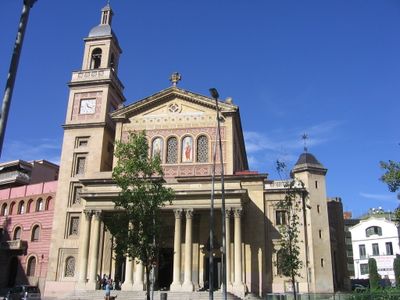
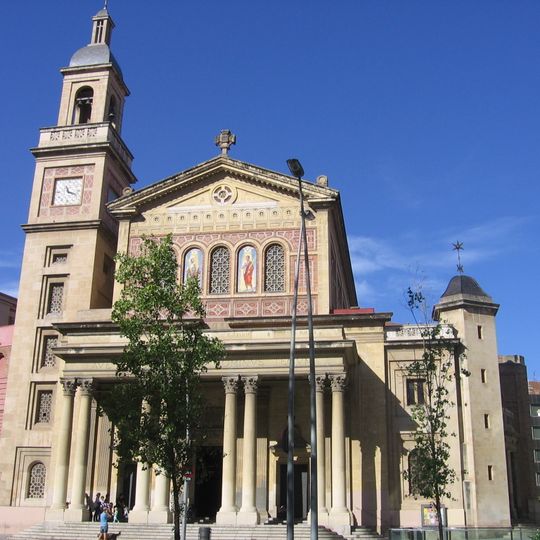
The Mare de Déu de la Bonanova is a Neo-Renaissance church on Plaça de la Bonanova, built from 1942 to 1962 to designs by Josep Danés i Torras and finished after his death by Joaquim Porqueras i Bañeres. Its façade has a portico of eight Corinthian columns above a stairway, inscribed Ave Gratia Plena Dominus Tecum, with a clock tower on the left and an octagonal tower topped by a bell-shaped dome and wind rose on the right. Inside, three naves are divided by round arches, with a coffered ceiling, mosaics by Lluís Bru and sgraffito and paintings by Francesc Labarta.
A chapel dedicated to Saints Gervasius and Protasius stood here from the 10th century at a spot called Creu Trencada, the origin of the village of Sant Gervasi de Cassoles. A Romanesque church replaced it in the 13th century and became a parish in 1245, sponsored by Pere de Montjuïc with his brother Arnau as first parish priest. The church was sacked in 1706 and 1714, rebuilt and enlarged in the 19th century, and destroyed in 1936, when its rector Lluís Xiró i Roig was killed. The present temple was built from 1942 to 1962 by Josep Danés i Torras, continued after his death in 1955 by Joaquim Porqueras i Bañeres.
The name comes from the Virgin of the Bonanova, devotion to whom arrived in the 17th century and displaced the martyr saints Gervasius and Protasius. Pope Leo XIII proclaimed her co-patroness of Sant Gervasi in 1883, and on 8 September 1900 Bishop Josep Morgades crowned her image canonically; the poet Jacint Verdaguer wrote a hymn for the occasion. The facade inscription reads Ave Gratia Plena Dominus Tecum.
The church is located at Plaza de la Bonanova 10-12 in the Sant Gervasi neighborhood and is easy to find. Visitors can attend regular Mass services throughout the week or explore the interior freely at most times.
The church's left bell tower carries a clock on each of its four faces, while the right-hand octagonal tower ends in a bell-shaped dome topped by a wind rose. The facade inscription reads Ave Gratia Plena Dominus Tecum, and two of the five upper arched windows hold images of Saints Gervasius and Protasius.
The community of curious travelers
AroundUs brings together thousands of curated places, local tips, and hidden gems, enriched daily by 94,095 contributors worldwide.