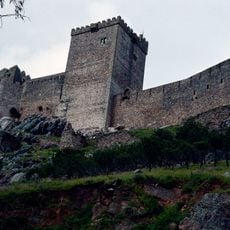
Castillo de Azagala, Medieval castle in Alburquerque, Badajoz, Spain
Castillo de Azagala is a 13th-century fortress in Alburquerque, Badajoz, built on a narrow east-west rocky crest about 140 metres long in the Sierra de San Pedro. Its elongated plan follows the ridge, with three defensive enclosures at different levels flanked by towers and walls of granite ashlar, rubble and masonry. The only entrance is on the western, less steep side.
Castillo de Azagala was raised in the 13th century, after the definitive reconquest of Alburquerque and its borderlands, to hold the defensive line against the Muslims of the south and later against Portuguese forces from the west. An inscription at the Torre de las Armas, bearing the arms of Martín Gil de Sousa, one of its two main promoters, gives the year 1303. The towers, cistern and most rooms date from the 14th and 15th centuries; in the 16th and early 17th the Order of Alcántara rebuilt walls and added service buildings.
The castle's name may derive from the Battle of Zalaca, Zagalla or Sagrajas, fought nearby in 1086 between Alfonso VI's Christian forces and Muslim troops who halted his advance south. The chapel inside the Torre de los Humos was dedicated to the Virgen del Carmen; no sacred object remains and it now stands empty.
The fortress is currently closed to visitors and requires substantial restoration work. You can view the structure from outside, but interior access is not permitted.
The Torre de los Humos takes its name from a large chimney inside it, and it still keeps part of its crenellated parapet. Its square plan and pyramidal merlons are documented in 16th-century papers, and the chapel it houses, dedicated to the Virgen del Carmen, is today empty.
The community of curious travelers
AroundUs brings together thousands of curated places, local tips, and hidden gems, enriched daily by 93,455 contributors worldwide.