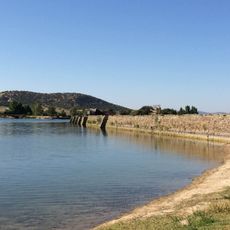
Monastery of San Isidro de Loriana, Gothic monastery in Mérida, Spain.
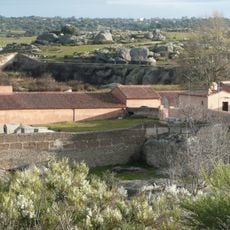
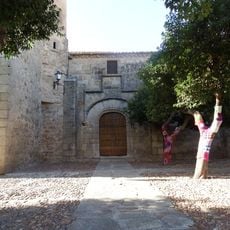
The Monastery of San Isidro de Loriana is a ruined 16th-century Franciscan complex in the municipality of Mérida, Badajoz. Its walls are built almost entirely of local slate slabs, with granite ashlars at the corners and brick in the arches. A small 5x5-metre cloister, framed by twelve Tuscan granite columns just over two metres high, supports eight semicircular arches.
Founded in 1551 by Fray Alonso del Manzanete, the monastery relocated to higher ground in 1605. The move addressed persistent moisture damage caused by its original location near the river.
The monastery takes its name from the Loriana stream, the Lourianilla or Lorianilla, a tributary of the Alcazaba. Its friars served the surrounding villages: records from Montijo, Lobón, La Roca de la Sierra and Puebla de Obando place them at local festivities and sermons. In 1729 the fifth Count of Montijo, Cristóbal Portocarrero y Villalpando, founded the Convent-Hospice of San Antonio in Montijo at the Loriana friars' request, as an infirmary and retreat for their sick.
The monastery stands on private land with restricted access, so visits must be arranged with the owner; it is not an open monument. The complex lies in the Loriana meadow near the Sierra de San Pedro, closer to La Roca de la Sierra and Puebla de Obando than to Mérida. The ruin is in an advanced state and threatens to collapse, so keep to a distance.
The cloister is a 5 by 5 metre patio framed by twelve granite Tuscan columns just over two metres tall, carrying eight round arches. Slate from the area, laid almost exclusively in flat slabs with granite ashlar at the corners, gives the walls their unusual look. The monastery was listed as a Bien de Interés Cultural on 12 November 2013.
The community of curious travelers
AroundUs brings together thousands of curated places, local tips, and hidden gems, enriched daily by 93,765 contributors worldwide.