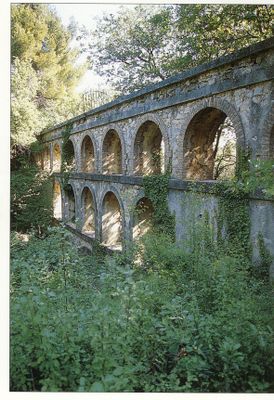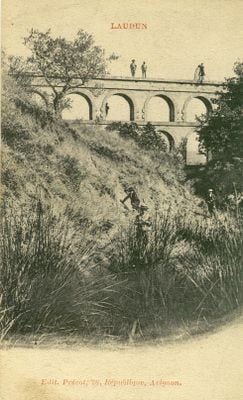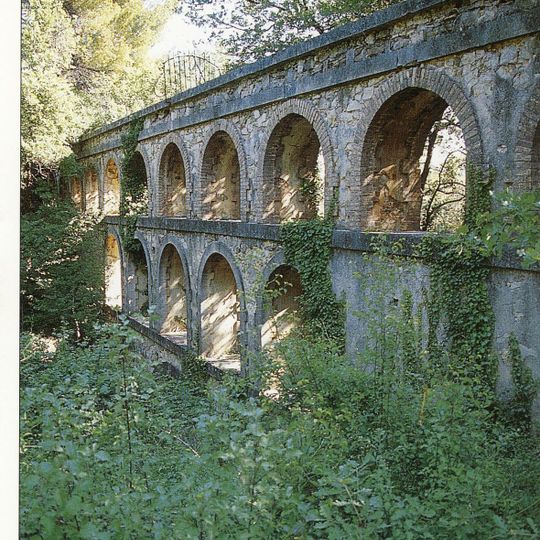
Balouvière Aqueduct, 19th century aqueduct in Laudun-l'Ardoise, France.
The Balouvière Aqueduct is a stone and brick structure that spans 62 meters across a dry stream valley with three rows of arches supporting a water channel. The construction combines the strength of stacked arches with a gentle slope to allow water to flow.
The structure was built in 1872 to transport drinking water to the region. It was created during a period when many French communities were modernizing their water supply systems.
The structure shows Roman engineering influences in its design, similar to the nearby Pont du Gard. The arrangement of arches and tiers reveals classical building methods that were common in the region at that time.
The structure is reachable on foot in about 10 minutes from the village center, with parking nearby at the Rue Florian and Rue Vincent Faita area. Access is straightforward, and the flat approach is suitable for a short walk.
The water originally came from a hill several kilometers away and flowed downhill through gravity alone, requiring no pumps. This system was a practical solution for the time that worked without modern machinery.
The community of curious travelers
AroundUs brings together thousands of curated places, local tips, and hidden gems, enriched daily by 91,907 contributors worldwide.