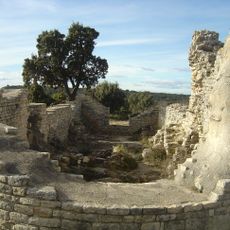
Camp de César, Archaeological site in Laudun-l'Ardoise, France.
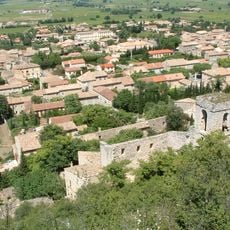
Camp de César is an 18-hectare ancient town on a rocky spur above the Rhone corridor and the confluence of the Cèze and Tave valleys, in Laudun-l'Ardoise. Its plateau entrance is barred by a 1.5-metre-thick defensive wall, once flanked by circular towers and pierced by three gates over five metres wide. Ruined walls of small pale beige and grey blocks, low terraced courses and loose stones remain.
The site was occupied from the 5th century BC Iron Age until Late Antiquity. Defensive walls were built in the 5th century BC, the 1st century BC and the 1st century AD, and a monumental centre with a forum, civil basilica and tribunal dates to the 1st century AD. Benedictine monastic cells on the western side were occupied until the 13th century.
The excavated forum and basilica show how people organized their settlement during Gallo-Roman times. You can see how craft quarters and religious spaces sat side by side, shaping daily life in this ancient community.
The location is accessible on foot or by bicycle and has marked paths with information boards at various spots. It is best to wear comfortable shoes and be prepared for uneven ground.
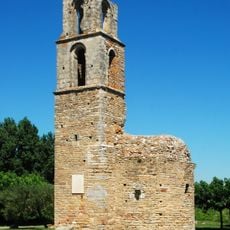
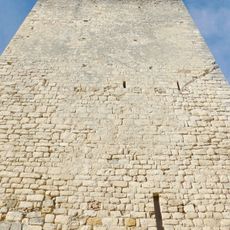
The entrance to the plateau is blocked by a defensive wall 1.50 metres thick that reinforces the natural defences of the rocky spur. It was flanked by circular towers, only one of which still stands tall, and pierced by three gates more than five metres wide. On the southern side, other fortification remains show how the whole plateau was put into defence.
The community of curious travelers
AroundUs brings together thousands of curated places, local tips, and hidden gems, enriched daily by 93,477 contributors worldwide.