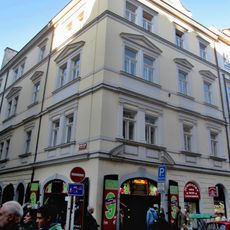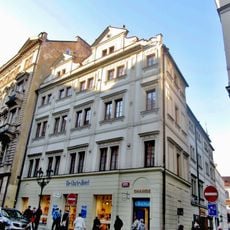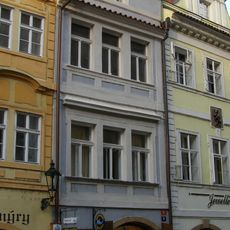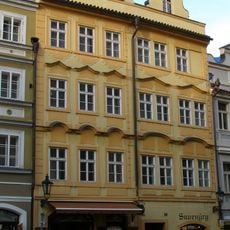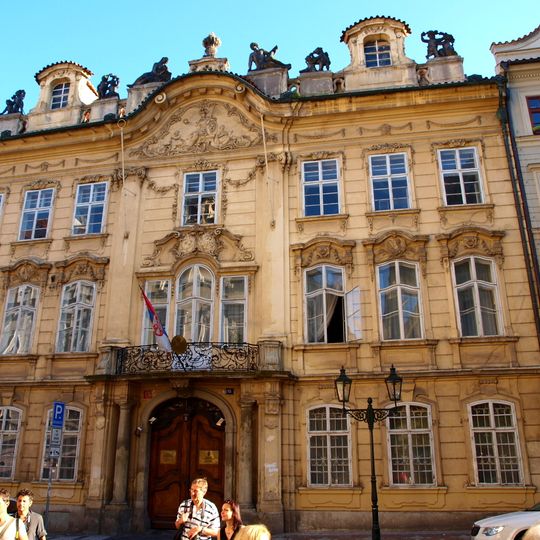
Kounic Palace, Baroque palace in Malá Strana, Czech Republic
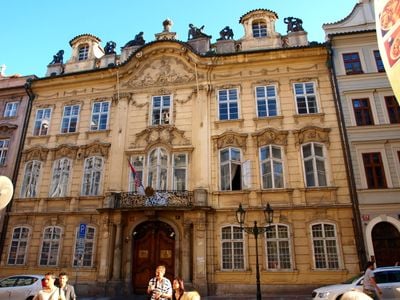
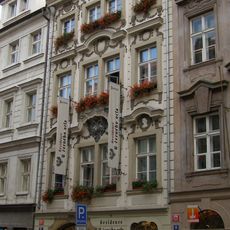
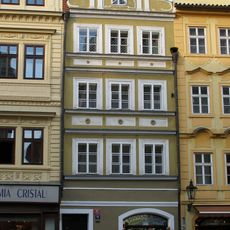
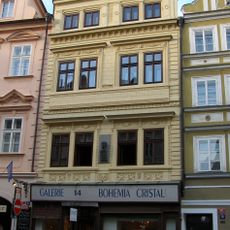
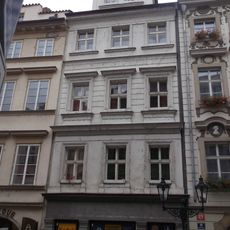
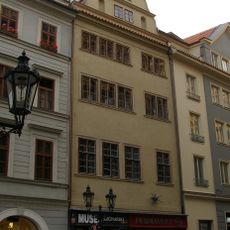
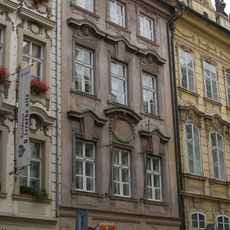
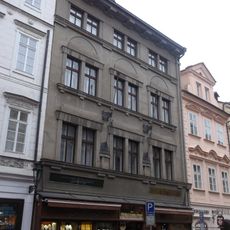
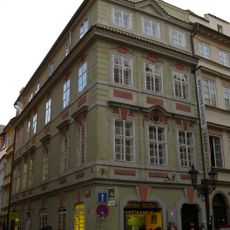
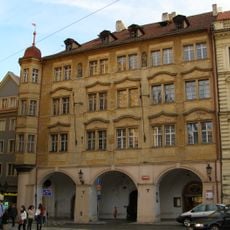
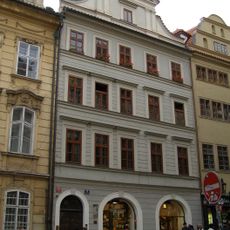
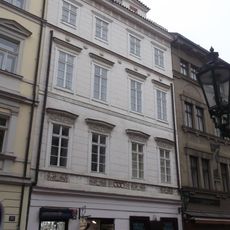
Kounic Palace is a two-storey Baroque palace at Mostecká 15 in Malá Strana, formed by remodelling two older Gothic houses. Its street facade marks the transition from Rococo to Neoclassicism: symmetrical, with a balcony above the entrance portal, a pediment bearing a relief of Pallas Athena, and an attic crowned by a decorative vase flanked by semi-reclining figures and putti. The building has a main block, two side wings and a rear wing.
The palace grew out of two older Gothic houses, later remodelled in Renaissance and Baroque style; in 1629 it belonged to Johann de Witte, Grand Master of the Knights of Malta. Count Jan Adolf of Kounice bought it in 1762, and around 1775 Antonín Schmidt rebuilt it in late Baroque form for his son Michal Karel. In 1931 it was adapted, and it now houses the Serbian embassy.
The palace carries several old house names: U zlaté ostruhy (At the Golden Spur), U stříbrné lišky (At the Silver Fox) and U stříbrné štiky (At the Silver Pike). Since 1931 it has housed the Serbian embassy, so the building is not open as a museum or exhibition venue.
Kounic Palace stands at Mostecká 15 in the Lesser Town, a short walk from Charles Bridge and Malostranská metro station. The Serbian embassy occupies the building, so visits are limited to the street facade; look up at the balcony and the tympanum relief of Pallas Athena above the portal.
The palace carries three older house names: U zlaté ostruhy (At the Golden Spur), U stříbrné lišky (At the Silver Fox) and U stříbrné štiky (At the Silver Pike). In 1629 it belonged to Johann de Witte, grand master of the Knights of Malta. Look for the relief of Pallas Athena in the tympanum above the entrance.
The community of curious travelers
AroundUs brings together thousands of curated places, local tips, and hidden gems, enriched daily by 93,603 contributors worldwide.