Altonaer Museum, History museum in Altona, Hamburg, Germany
The Altonaer Museum is a history museum in the Hamburg district of Altona, documenting northern German life and development from the 18th century to today. Its collections cover paintings, furniture, crafts, and everyday objects from the Elbe region.
Pastor Georg Schaar, naturalist Carl Christian Gottsche and shipowner Ernst Dreyer founded a private society in February 1863 to build a museum at Palmaille 112, initially holding mainly botanical collections. After a brief closure in 1888 it passed to the city, and the new building by Heinrich Reinhardt and Georg Süßenguth opened on 16 September 1901. Teacher Otto Lehmann, director from 1899 to 1931, centred it on Schleswig-Holstein regional and folklore studies.
The museum displays paintings made when Altona was under Danish rule, showing life along the coast and on the water. These works give a concrete sense of how closely the region was once tied to the sea.
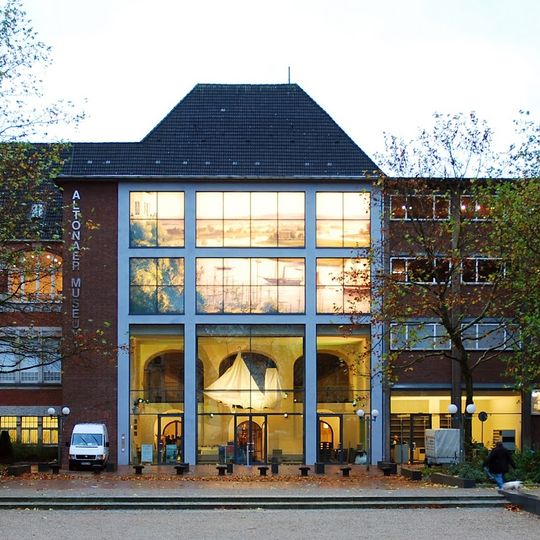
The museum stands between the Platz der Republik and the Museumstraße, near the Altona railway station. Since 1980 a fire-damaged section was rebuilt and the exhibition area grew to around 8,500 m², partly using the neighbouring former watchmaking school built by Gustav Oelsner in 1928. The Kinderbuchhaus is a separate institution inside the main building, and the Heine-Haus in the Heine-Park on the Elbchaussee serves special exhibitions.
The museum holds 17 reconstructed northern German farmhouse rooms that show how people lived and worked in the region generations ago. Among them is an original 1890s country store from Altenwerder, kept intact down to the smallest details on the shelves.
The community of curious travelers
AroundUs brings together thousands of curated places, local tips, and hidden gems, enriched daily by 93,120 contributors worldwide.