Porta Nigra, Roman city gate in Trier, Germany
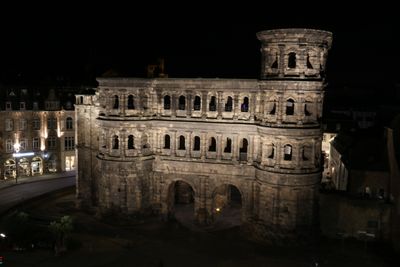
Porta Nigra is a Roman city gate in Trier, Germany, built from large grey sandstone blocks that rest on each other without any binding material. Iron clamps hold the stones together, and the structure consists of two tower blocks connected by a narrow inner courtyard.
The gate was built in 170 AD as one of four entrances in the Roman city wall but was never finished. A Greek monk named Simeon lived inside as a hermit starting in 1028, after which the building was converted into a church.
Locals simply call the gate "the Porta". The name Porta Nigra, Latin for "Black Gate", dates from the Middle Ages and probably comes from the dark colour of the weathered Kordel sandstone; it is first recorded in the 12th-century Gesta Treverorum. The Roman name is lost.
The gate is open daily and visitors can walk through the towers and the inner courtyard to see how the building was put together. On some days, actors dressed in Roman clothing lead tours and explain the construction and purpose.
Napoleon ordered the removal of church additions in 1804 to restore the Roman appearance, but he allowed the medieval apse on the eastern side to remain. This stone half-circle from the church period is still visible today.
The community of curious travelers
AroundUs brings together thousands of curated places, local tips, and hidden gems, enriched daily by 92,382 contributors worldwide.