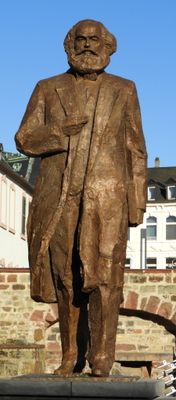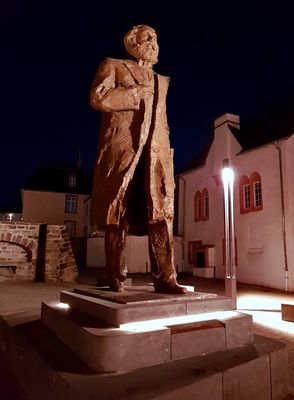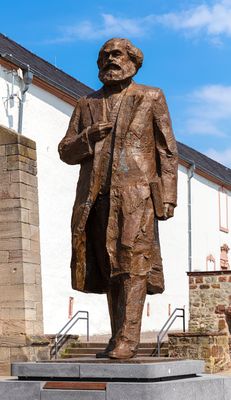
Karl Marx statue in Trier, Bronze statue on Simeonstiftplatz, Trier, Germany
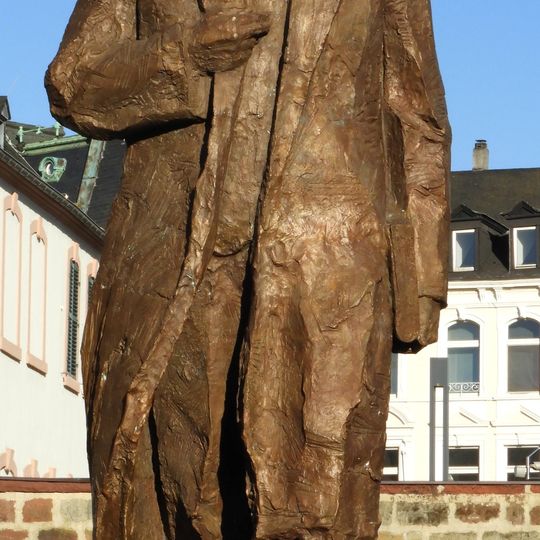
The Karl Marx statue in Trier is a 2.3-tonne bronze figure, 5.50 metres tall with its base, standing on Simeonstiftplatz. Marx, shown in later years, strides forward in a long, roughly modelled overcoat, his right hand at the lapel and a book in his left. The stepped pentagonal base is concrete clad in basalt slabs.
The statue was first planned as a life-size gift for the area in front of Marx's birth house, the Karl-Marx-Haus, but China announced a larger work and a new site was found at Simeonstiftplatz. Trier's city council debated whether to accept a gift by a state-affiliated artist; a majority of SPD, CDU, the Left and parts of the Greens approved it. It was unveiled on 5 May 2018, Marx's 200th birthday, with Mayor Wolfram Leibe and Minister-President Malu Dreyer among the speakers.
The statue is a gift from the People's Republic of China, presented as part of a foreign-policy push under Xi Jinping; Trier's council accepted it in a contested vote, with the FDP, AfD and some Greens opposed. On the day of the unveiling, Falun Gong activists, banned in China, held a vigil nearby.
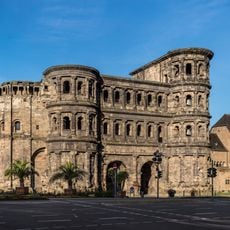
The statue stands on the open paved Simeonstiftplatz, a short walk from the Porta Nigra, so both can be seen on foot in one outing. The stepped concrete base has no railing or ramp; visitors view it at ground level from the surrounding paving. The bronze is exposed to the weather year-round, and the square stays open without a gate.
The five corners of the stepped base point to Trier, Berlin, Hamburg (seat of Marx's publisher Otto Meissner), Paris and London. Trier itself paid €39,000 for earthworks, foundation, paving and lighting; the total cost was €92,500.
The community of curious travelers
AroundUs brings together thousands of curated places, local tips, and hidden gems, enriched daily by 92,676 contributors worldwide.