Cathedral of Trier, Roman Catholic cathedral in Trier, Germany
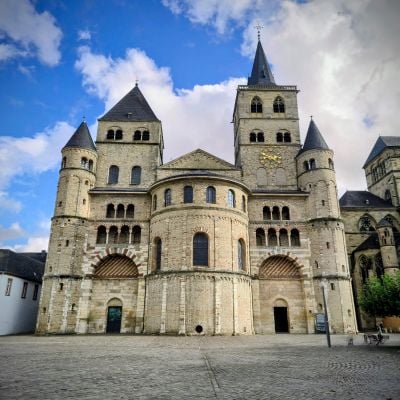
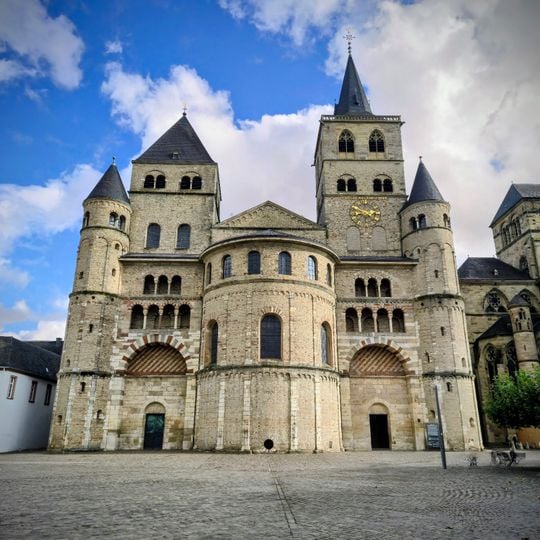
The Cathedral of Trier is the oldest episcopal church in Germany, measuring 112.5 by 41 meters. Its Romanesque westwork has four towers around a western apse; the tallest carries a clock and the Latin inscription "NESCITIS QVA HORA DOMINVS VENIET". The interior is a three-aisled hall with Gothic rib vaults and cruciform piers enclosing four Roman columns.
A basilica was built between 310 and 320 under Constantine, and Bishop Maximin expanded it into one of the largest church complexes in Europe with four basilicas and a baptistery. Around 340 the square core arose with four monumental Odenwald granite columns. After fires and the Viking destruction of 882, Archbishop Egbert began rebuilding, continued by Poppo from 1016, whose Salian westwork was completed by Eberhard; the east choir altar was consecrated in 1196.
The Holy Robe, kept in the Chapel of the Holy Tunic behind the east choir, was moved there in 1512 after its recovery from the previous main altar. It is shown only rarely, most recently in 2012. The east crypt displays the skull of St. Helena, mother of Constantine.
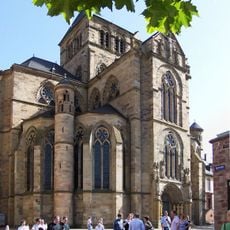
The westwork with its four towers and western apse forms the entrance front; the interior measures 112.5 by 41 metres. The Chapel of the Holy Tunic was added behind the east choir in the early 18th century and is seen through an opening in the wall. The Gothic cloisters, built between 1245 and 1270, adjoin the cathedral.
Roman walls from the fourth century still run through the lower sections of the cathedral walls and form the base for the medieval architecture. These ancient stones were integrated into later building phases and remain visible in several places.
The community of curious travelers
AroundUs brings together thousands of curated places, local tips, and hidden gems, enriched daily by 92,783 contributors worldwide.