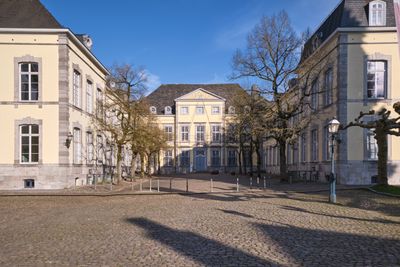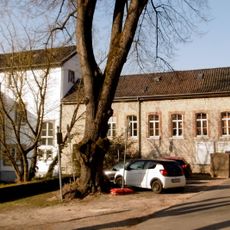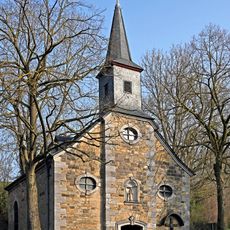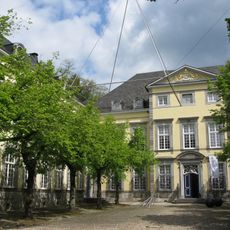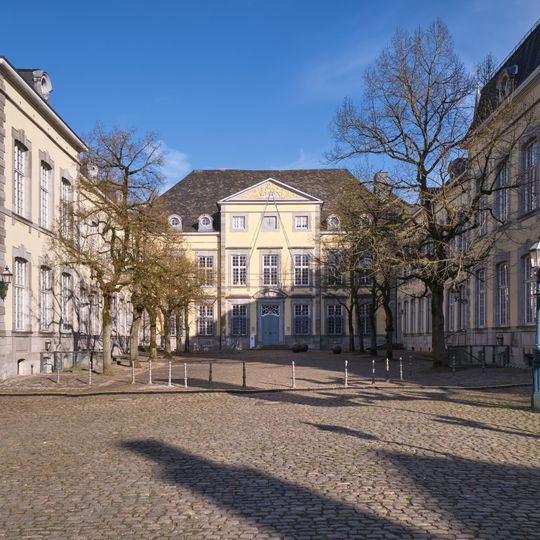
Kornelimünster Abbey, Benedictine monastery in Kornelimünster, North Rhine-Westphalia, Germany
Kornelimünster Abbey is a Benedictine monastery re-founded in 1906 about a kilometre west of the former Imperial Abbey in Kornelimünster, a district of Aachen. The monks came from Merkelbeek Abbey in the Netherlands; the community belongs to the Subiaco Cassinese Congregation and had eight monks in 2022. The former abbey buildings, including the abbey church of St Cornelius, now serve as a museum of modern art.
Founded around 814 by Benedict of Aniane, adviser to Emperor Louis the Pious, the monastery was first called Monasterium Salvatoris ad Indam. In 875 half of a shroud was exchanged for the head relic of Pope Cornelius, who died in 253, giving the abbey its later name. It was dissolved in 1802 during secularisation and re-founded by Benedictines in 1906 about a kilometre away.
The abbey's name comes from Pope Cornelius (died 253), whose head relic was acquired in 875 in exchange for half of a shroud. Since the 14th century this relic has drawn pilgrims to the Heiligtumsfahrt, a pilgrimage once ranked with Rome, Jerusalem and Santiago de Compostela. The church, now the parish church of St Cornelius, still holds the reliquary.
This location sits along the Way of Saint James pilgrimage route and welcomes travelers seeking accommodation and retreat spaces, though advance notice is needed. The monastery grounds are well-maintained and accessible, and visitors should observe respectful behavior in the sacred spaces.
The abbey's relics included a loincloth, a sudarium and two shroud-like cloths given by Louis the Pious. In 875 one shroud was divided, half going to Charles the Bald for Compiègne; in exchange the abbey received the head relics of Pope Cornelius and Saint Cyprian. Cornelius's veneration gave the monastery and later the village its name.
The community of curious travelers
AroundUs brings together thousands of curated places, local tips, and hidden gems, enriched daily by 93,145 contributors worldwide.