Siegestor, Triumphal arch at Leopoldstrasse, Germany
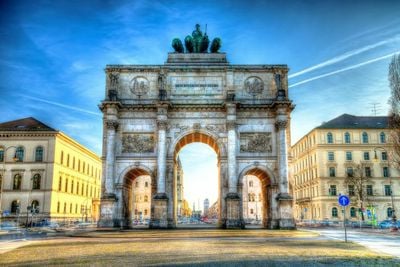
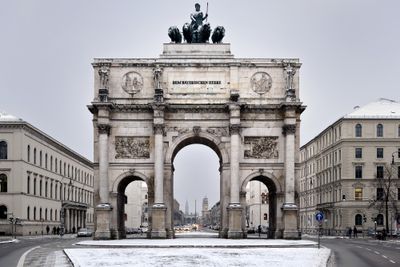
The Siegestor is a neoclassical triumphal arch of Kelheim limestone, 21 meters high, 24 meters wide and 12 meters deep, with a tall central passage and two smaller flanking arches. Four fluted columns with carved capitals stand between the arches, and the flat attic carries the inscription 'DEM SIEG GEWEIHT VOM KRIEG ZERSTÖRT ZVM FRIEDEN MAHNEND'. A 22-ton quadriga with a six-meter Bavaria driving four lions crowns the top.
Ludwig I commissioned Friedrich von Gärtner in 1840 to design a triumphal arch modeled on Rome's Arch of Constantine, built in Kelheim limestone from 1843 to 1850; after Gärtner's death in 1847, Eduard Metzger took over. Maximilian II handed it to Munich on 15 October 1850, though Ludwig stayed away. Severely damaged in World War II, it was rebuilt from 1958 under Josef Wiedemann, with a new peace inscription on the south side.
The south side bears the inscription "Dem Sieg geweiht – Vom Krieg zerstört – Zum Frieden mahnend", written by journalist Hanns Braun and designed by Franz Hart after the war. The north side keeps the original dedication "Dem Bayerischen Heere". The quadriga's lions refer to the heraldic charge of the House of Wittelsbach.
The arch stands at the intersection of Ludwigstrasse and Leopoldstrasse, marking the boundary between the Maxvorstadt and Schwabing districts. Visitors can approach from multiple directions and explore the surroundings on foot.
The quadriga weighs 22 tons, not 20, and carries a six-metre Bavaria steering four lions rather than horses. The lions refer to the heraldic charge of the House of Wittelsbach. Johann Halbig supplied the lion team to Johann Martin von Wagner's design, and Friedrich Brugger modelled the Bavaria.
The community of curious travelers
AroundUs brings together thousands of curated places, local tips, and hidden gems, enriched daily by 93,172 contributors worldwide.