Old parish church of St. Martin, Gothic church in Garmisch-Partenkirchen, Germany
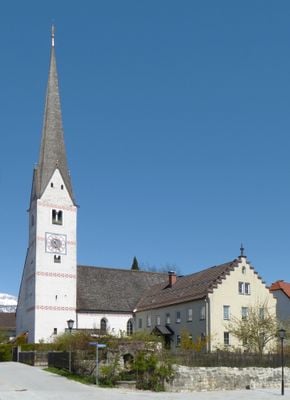
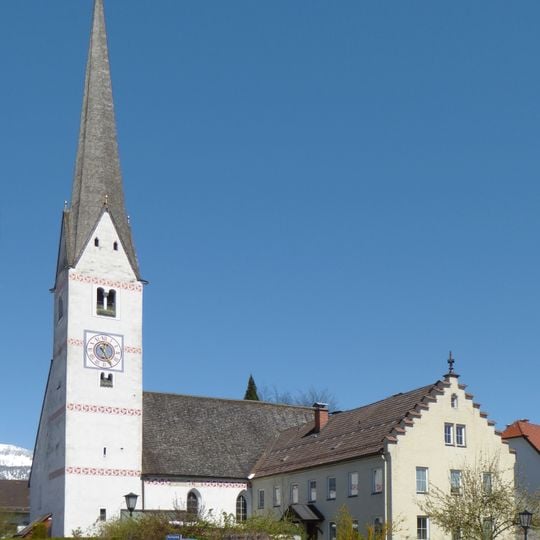
Alte Pfarrkirche St. Martin is a Romanesque-Gothic church on the edge of Garmisch. Its tall tower carries a slender, shingled spire with a white rim, a red-bordered clock face and two narrow arched windows; red patterns mark the white lower walls. The nave has a steep shingled roof, and a smaller white building with a stepped gable stands beside it. Inside, a late-Gothic net vault rests on a central column, dividing the space into two naves.
Garmisch is first documented in 802, and its church, dedicated to St Martin, probably began as a Merovingian wooden building. A stone Romanesque successor was replaced around 1288 by an early Gothic natural-stone church, recorded that year as the parish church; remains survive in the nave's north wall and the tower. A west gallery followed in 1446, an eastern presbytery in 1462, and the south wall and late Gothic vaulting in 1520/22. After the Baroque New Parish Church was built by Joseph Schmuzer in 1730–1734, the old church stood at the village edge and was used as a hay barn.
The church's patron is St Martin, the most important saint of the Frankish realm, and the parish once covered the whole upper Loisach and Isar valleys. The wall paintings worked as an "Armenbibel", teaching scripture to an unlettered congregation. The high altar of 1669 is by cabinetmaker Thomas Ziegler and sculptor Johannes Schenk; the altarpiece by Innsbruck painter Johannes Hartwig is lost.
The church stands slightly apart at the edge of Garmisch, not in the centre; the neo-Gothic girls' school of 1852/54 is built onto its south-east side. Entry is from the west, through a two-bay vaulted gallery under the former west gallery, into the nave. The old south-west portal is blocked by a modern Lourdes grotto, so look for the west door.
The church was saved from demolition only because it served as a hay barn after the New Parish Church opened in 1734. In 1877 wall paintings were found in the choir, and the large figure of St Martin on the east wall was uncovered only in 1958; the frescoes were cleaned and restored between 1990 and 2000.
The community of curious travelers
AroundUs brings together thousands of curated places, local tips, and hidden gems, enriched daily by 94,980 contributors worldwide.