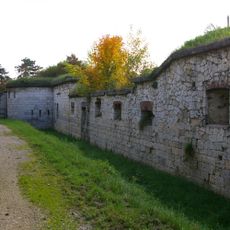
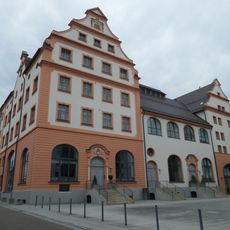
Söflingen Abbey, Monastery and church building in Söflingen district, Ulm, Germany.
Söflingen Abbey is a former Poor Clares convent in the Söflingen district of Ulm. The complex, now called Klosterhof, retains the former abbey church and several large economic buildings, including the former mill and the brewery, grouped around a courtyard. The church interior shows a painting with a crowned woman in a blue cloak holding a child on a globe, flanked by a kneeling brown-robed man and a grey-habited nun, with a walled red-roofed complex below.
The community was first documented in 1237 on the Danube near Ulm and moved to Söflingen before 1253; Count Hartmann IV of Dillingen donated the site in 1258. Abbess Elisabeth Reichner, installed in 1484, reformed the convent and rebuilt it in 1492. After a 1768–1773 lawsuit, Ulm renounced its claims and the abbey became an imperial foundation in 1773.
The Söflinger Briefe and Söflinger Lieder, letters and songs written down in the 15th century, record the nuns' mystical piety and are among the few surviving witnesses of convent life here. The abbey also issued its own law code for the village of Söflingen in 1392, an early sign of its territorial authority.
The complex is freely accessible, allowing visitors to view the architecture and visit the church. It is wise to check in advance whether guided tours or special opening hours apply to certain areas, since not all parts of the complex are open to the public at all times.
The community specialized in producing wine and other goods that were traded far beyond the region, securing its economic survival. This craft skill made the monastery more than just a place of prayer, turning it into an important economic center of the surrounding area.
The community of curious travelers
AroundUs brings together thousands of curated places, local tips, and hidden gems, enriched daily by 94,366 contributors worldwide.