Schaubühne am Lehniner Platz, Performance theater in Charlottenburg-Wilmersdorf, Germany.
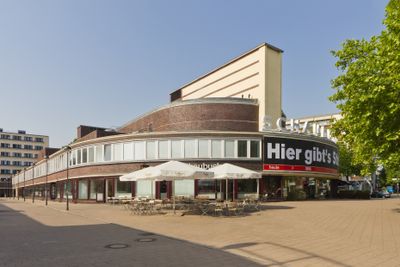
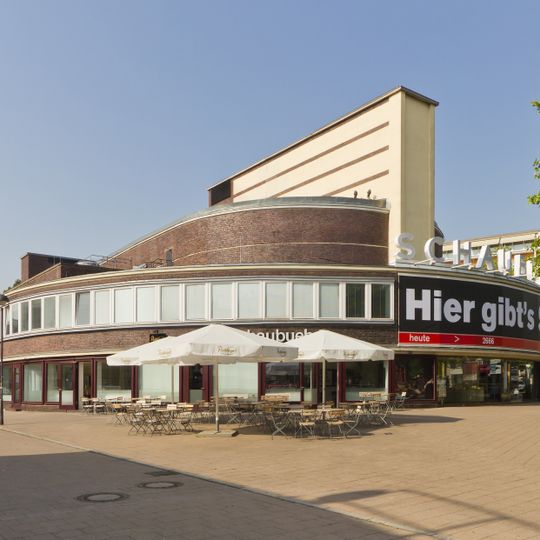
Schaubühne am Lehniner Platz occupies Erich Mendelsohn's curved brick Universum cinema of 1928, part of the WOGA complex on Kurfürstendamm. Its rounded facade faces a paved square; a cream vertical section carries the raised letters "SCHAUBÜHNE". Jürgen Sawade's 1978–1981 conversion created a flexible interior without a fixed separation between audience and stage.
Erich Mendelsohn designed the rounded building in the New Objectivity style as the Universum cinema, which opened in 1928 as Berlin's largest cinema and the centrepiece of the WOGA complex on Lehniner Platz. Damaged in the Second World War, it was rebuilt and used again as a cinema, then from 1969 as a dance hall and musical theatre. Listed as a monument in 1979, it was converted from 1978 to 1981 by architect Jürgen Sawade into a theatre for the Schaubühne ensemble.
The theatre's name refers to its ensemble, founded in 1962 in a Kreuzberg welfare hall; Jürgen Schitthelm led it until 2012, the longest-serving director in Germany. Since 2004 Carolin Emcke has moderated the monthly "Streitraum" panel on politics. The black band on the facade advertises the current production, such as "2666".
The theatre sits on the Kurfürstendamm boulevard at Lehniner Platz in Wilmersdorf, part of the WOGA complex; the rounded brick front faces the paved square, where café tables stand. The interior has no fixed separation between audience and stage, so seating layout varies by production.
The cinema that preceded the theatre was possibly the first Modernist cinema in the world, built against the Moorish, Egyptian and baroque styles then common. Mendelsohn summed up his aim in a short text: "no Baroque palaces for Buster Keaton". Its design influenced Streamline Moderne cinema architecture in the 1930s.
The community of curious travelers
AroundUs brings together thousands of curated places, local tips, and hidden gems, enriched daily by 94,196 contributors worldwide.