Sigmaringen Castle, Gothic Revival castle in Sigmaringen, Germany
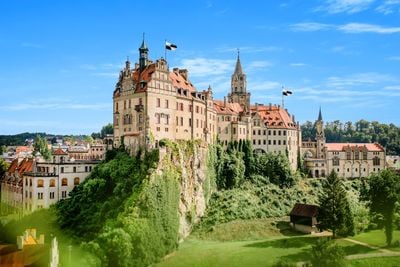
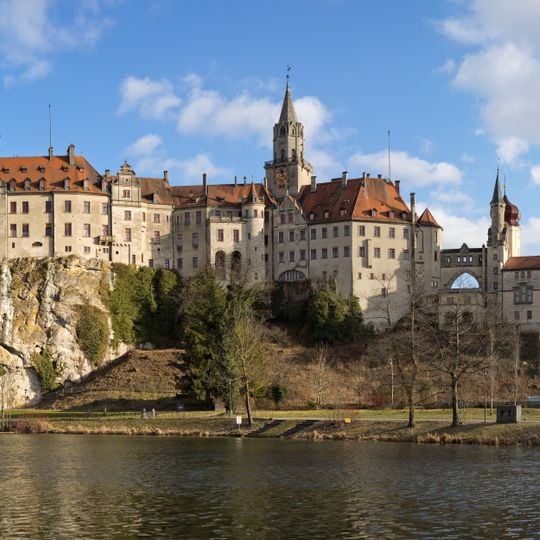
Sigmaringen Castle is a multi-winged castle of pale stone on a limestone rock above the Danube. Its steep red-tile roofs are punctuated by dormers and slender chimneys, and a tall square clock tower with a pointed spire rises on the left. Below the main range, a long lower hall with red-framed windows and corner turrets with green copper roofs stands beside the water.
A first castle on the rock was mentioned in 1077, during Rudolf of Rheinfelden's failed siege against Henry IV. Around 1200 the Helfenstein counts rebuilt it in buckel stone, and from 1460 to 1500 the Werdenberg counts converted the fortress into a residence, adding two long northeast wings and the two round entrance towers. In 1535 Charles I became the first Hohenzollern to rule here; after fires in 1539 and 1633, Meinrad I had the burned eastern parts rebuilt by Michael Beer in 1658–59.
The weapons and armor collection shows how people across centuries understood warfare and protection through their craftsmanship. Visitors see pieces from different eras that reveal how fighting techniques and metalwork evolved over time.
Access is through guided tours conducted in German, with translation materials available by request throughout the year. The site requires some physical fitness due to slopes and stairs both inside and around the building.
During the final phase of World War II, the castle served as a temporary seat for the French Vichy government from 1944 to 1945. This brief episode connected the building to one of Europe's darkest historical chapters.
The community of curious travelers
AroundUs brings together thousands of curated places, local tips, and hidden gems, enriched daily by 93,130 contributors worldwide.