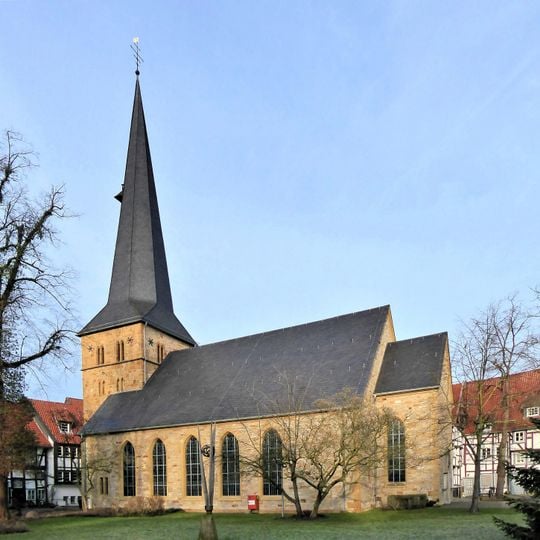
Apostelkirche, Protestant church in Gütersloh, Germany.
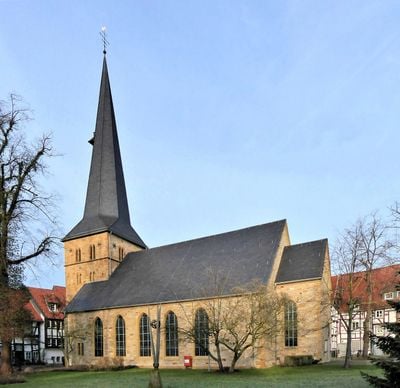
The Apostelkirche is a church with a light tan stone tower topped by a dark slate spire and a clock face, and a main body with a steep slate roof and tall arched windows. It was rebuilt in 1951 as a hall church with a pointed barrel vault and about 400 seats, reusing four corner columns with late Romanesque leaf capitals from the destroyed choir.
A wooden chapel may have stood here around 800; the first stone church dates from 1201, and its wall remains survive in the tower after a fire around 1500. From 1655 to 1890 Protestants and Catholics shared the building as a Simultankirche under the name St. Pankratius. Bombing on Totensonntag 1944 destroyed the three-nave hall church except the Gothic tower; Werner March's new barrel-vaulted hall church was begun in 1951.
Until 1890 the church was called St. Pankratius; the Catholics took that patron saint with them to their new church near the Alten Kirchplatz, and the building became the Apostelkirche. The oldest of the five bells, cast in 1640, is still named Pancratius. A chandelier from 1743 hangs in the tower hall.
The church stands on the Alte Kirchplatz, the historic centre of Gütersloh, and the entrance is at the base of the tan stone tower with its clock face. The 1951 hall church lies east of that tower, so enter through the tower hall to reach the roughly 400 seats. The organ by Paul Ott, with 26 registers on two manuals and pedal, sits inside.
The tower hall holds a chandelier dated 1743, older than the present church body. Four corner columns with late Romanesque leaf capitals were salvaged from the destroyed choir and reused in the 1951 rebuild. The oldest of the five bells, called "Pancratius", was cast in 1640; the other four were donated by the businessman Fritz Husemann in 1956.
The community of curious travelers
AroundUs brings together thousands of curated places, local tips, and hidden gems, enriched daily by 93,837 contributors worldwide.