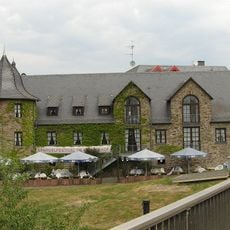
Hadamar Castle, Renaissance palace in Hadamar, Germany.
Hadamar Castle is a Renaissance palace in the town of Hadamar featuring multiple floors with residential quarters, grand halls, and a central courtyard. Its interiors display painted ceilings and furnishings from different periods, reflecting the building's long construction history.
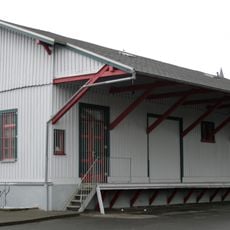
In 1320 Count Emich I of Nassau acquired the Eberbach monastery farm and built a moated castle, with a tithe barn to its south. The north and east wings largely rest on the monastery's L-shaped foundations, and the old chapel apse remains visible in the north wing. Johann Ludwig began converting it into a palace in 1612; the north and east wings were rebuilt by 1617 and the south wing completed in 1629.
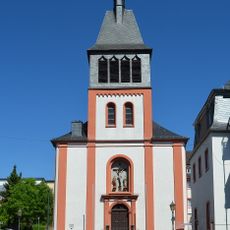
The castle church in the east wing has served Hadamar's Protestant congregation since 1791. The former monastery chapel was split horizontally by a inserted ceiling during Johann Ludwig's renovations, creating two rooms. The adjacent economic buildings now house the town museum and a court, while the castle itself is used as an administrative building.
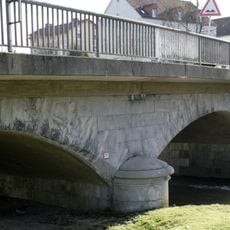
The castle stands on the left bank of the Elbbach, at the edge of Hadamar's medieval core. The main road through town once passed through its courtyards. The complex now houses government offices, while the adjoining economic buildings hold the town museum and a court; the castle church in the east wing serves the Protestant congregation.
The castle's main tower was originally the stair turret of the south wing; it was later raised by three storeys and given a helm roof, so it now overtops the whole complex. The former castle mill, moved to the mouth of the Faulbach in 1705, survives as a plastered half-timbered building from around 1800.
The community of curious travelers
AroundUs brings together thousands of curated places, local tips, and hidden gems, enriched daily by 94,050 contributors worldwide.