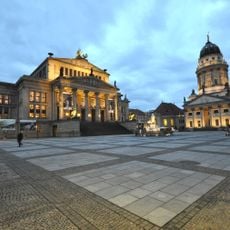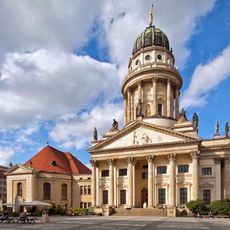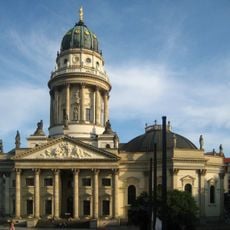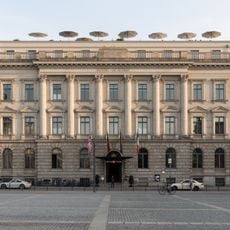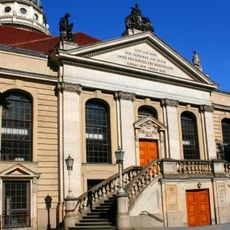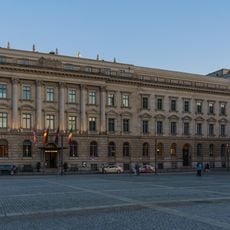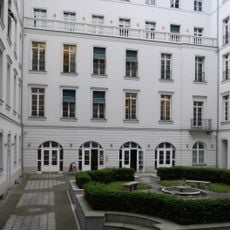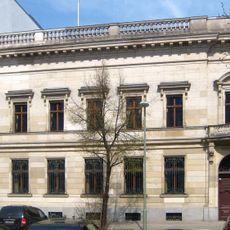
Konzerthaus Berlin, Concert hall in Gendarmenmarkt, Berlin, Germany.
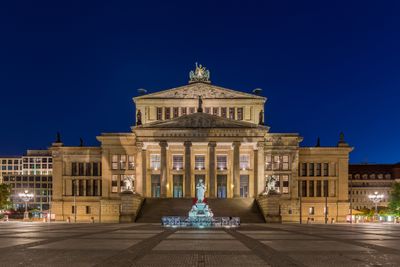
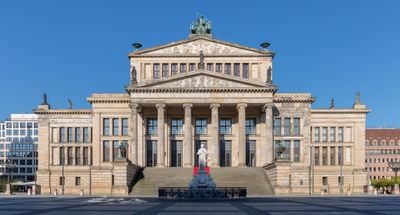
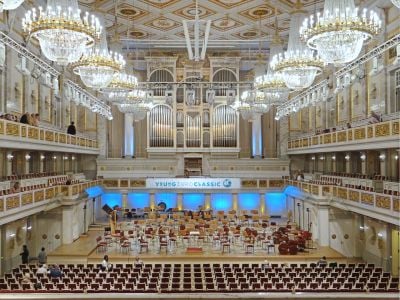
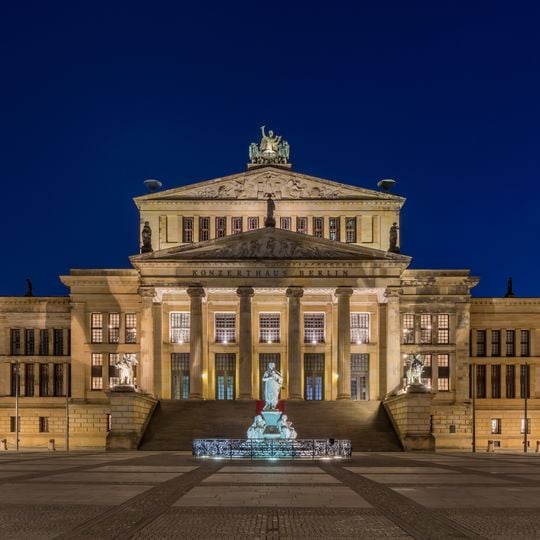
Konzerthaus Berlin is a neoclassical structure on Gendarmenmarkt in central Berlin, with a main auditorium that seats approximately 1500 people. The interior features white and gold decorative elements characteristic of neoclassical design.
The predecessor, Carl Gotthard Langhans's National-Theater, burned down on 29 July 1817 during rehearsals of Schiller's Die Räuber. Karl Friedrich Schinkel built the new Königliches Schauspielhaus from 1818 to 1821, reusing the old foundations and portico columns; it opened on 18 June 1821 with Weber's Der Freischütz. In September 1848 the Prussian National Assembly met in its auditorium. After wartime destruction it was rebuilt from 1977 and reopened in 1984; in 1994 it was renamed Konzerthaus Berlin.
The building opened in 1821 as the Königliches Schauspielhaus; the name Konzerthaus Berlin dates only from 1994. Its resident orchestra is the Konzerthausorchester Berlin, and each summer the hall hosts Young Euro Classic, an international festival of youth orchestras. The frieze over the columns reads "KONZERTHAUS BERLIN".
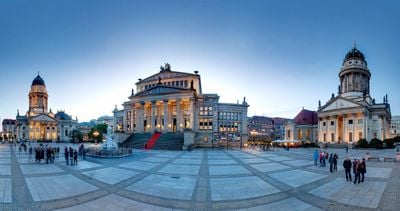
The hall stands on the Gendarmenmarkt in Berlin-Mitte, with the main entrance reached by the wide flight of steps beneath the six-column portico. The interior was adapted for concert use in the 1977–1984 reconstruction, so the auditorium differs from Schinkel's original theatre layout. The building is a working concert venue, not a museum: access to the hall depends on concerts, guided tours or events.
The great hall's organ was built in 1984 by Jehmlich Orgelbau Dresden: four manuals and pedal, 74 stops and 5,811 pipes. It stands behind the stage under a rounded arch, framed by columns and flanked by two side arches. In 2004 the hall's acoustics were ranked among the five best concert venues in the world for music and opera.
The community of curious travelers
AroundUs brings together thousands of curated places, local tips, and hidden gems, enriched daily by 93,201 contributors worldwide.