Graben, Castle ruin in Neustädterhof, Obernburg am Main, Bavaria, Germany
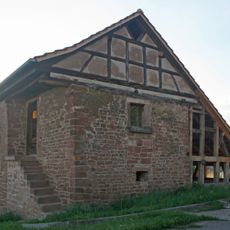
The Bacheburg is the ruin of a small late-medieval water castle built in 1403 by Jorg Bache von Nuwenstat. Its two lower storeys were of stone, the upper of timber framing, and a six-metre-wide moat surrounded it. Today only the northwest gate arch with remains of the gatehouse, reached by a drawbridge, and parts of the ring wall on the northeast side survive.
Jorg Bache von Nuwenstat built the small water castle in 1403 on family land near the church of Neustädterhof, where the family was probably buried. He had to enfeoff it to the Counts of Wertheim, and his sons Hans and Madern attacked travellers under the escort of the Archbishop of Mainz. In 1440 riders of Archbishop Dietrich Schenk von Erbach took and destroyed the castle; Hans had to stay a year under house arrest in the burnt ruin, and in 1441 the brothers sold the remaining property.
The name Bacheburg comes from the Bache von Neustadt family, and the ruin is also called Untere Burg, lower castle, to distinguish it from the earlier Schneirersbuckel motte. A four-heraldry stone that once stood above the entrance is now set into the rear wall of Obernburg's town hall.
The ruin stands in open fields about 150 metres southwest of the Mümling, east of the access road from the B 426 to Neustädterhof. It can only be visited outside periods of field cultivation, after the harvest and in winter. There are no information panels on site.
The castle had two lower stone storeys and timber-framed upper floors, and was surrounded by a roughly six-metre-wide moat whose silted remains are still visible. Around 1700 the robber known as "Belljouseph" (Betteljosef) used the walls as a hideout, and in 1750 a whole band of thieves was captured in the ruin.
The community of curious travelers
AroundUs brings together thousands of curated places, local tips, and hidden gems, enriched daily by 93,953 contributors worldwide.