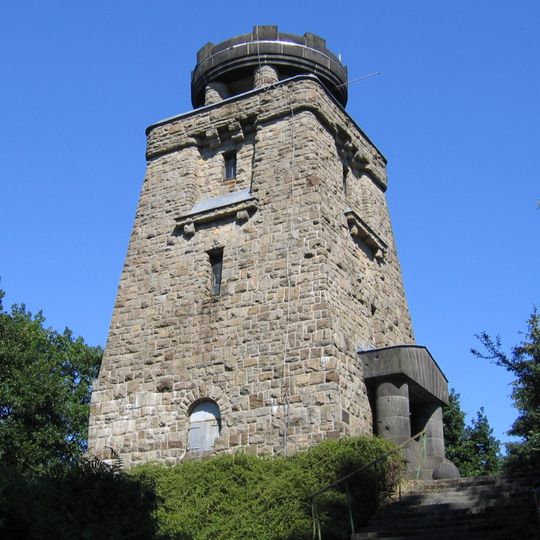
Bismarck tower, Memorial tower in Iserlohn, Germany
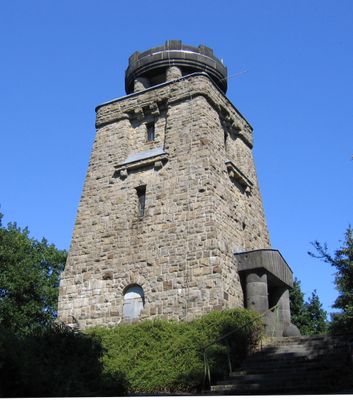
Bismarck tower is a 14.7-metre memorial tower on the Seilerkuppe above the Seilersee, at 338 metres above sea level. Its square shaft, 7.50 metres on each side, rests on a three-stepped base and a rectangular plateau. A south portal with steps leads to a stone stair of 44 steps and a spiral stair of 13 steps up to the viewing platform at 11 metres; a five-metre round fire bowl sits above it. The walls are greywacke, with basalt lava for the portal and bowl exterior.
In 1911 Karl Weydekamp proposed a Bismarck tower for Iserlohn; a committee formed on 1 April 1913, and citizens donated 25,000 marks. The foundation stone was laid on 6 September 1914, and the tower opened on 31 March 1915. The fire bowl was first lit the next day, Bismarck's 100th birthday. From 1940 the Wehrmacht used it, and after the war the British military ran a radio control centre there.
The tower's fire bowl was first lit on 1 April 1915, Bismarck's 100th birthday, and the flame was rekindled in 1990 by mayor Fritz Fischer for the 75th anniversary. Since then a memorial plaque has hung on the tower, and volunteers from the Aktionskreis Pater Beda open it on several Sundays from April to September.
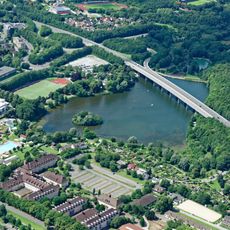
The tower stands on the Seilerkuppe at 338 m, about 130 m above the Seilersee dam. Interior visits and climbs are possible only by prior arrangement with the city of Iserlohn; the Aktionskreis Pater Beda also opens it on several Sundays from April to September. The viewing platform is reached by a 44-step stone stair and a 13-step spiral stair.
Eight solar modules on the roof, invisible from below, power an amateur radio relay station. The tower also served as a radio control centre for the British military after the Second World War, and from 1940 the Wehrmacht used it.
The community of curious travelers
AroundUs brings together thousands of curated places, local tips, and hidden gems, enriched daily by 94,482 contributors worldwide.