Maste-Barendorf, Historic factory museum in Iserlohn, Germany
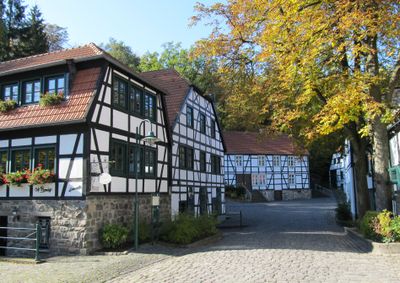
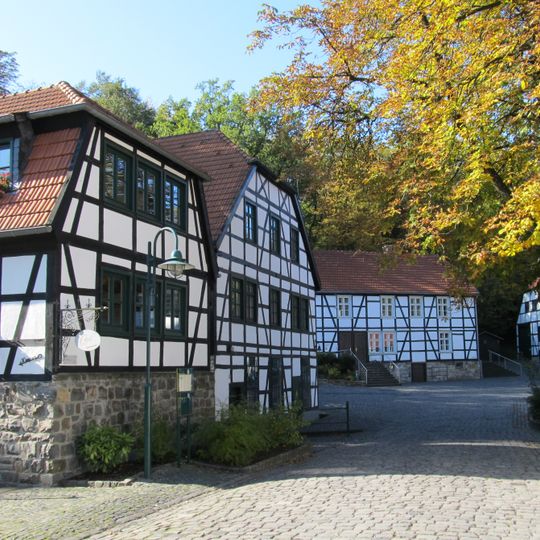
Maste-Barendorf is a 19th-century industrial settlement of ten buildings north of Iserlohn on the Baarbach stream, founded by the manufacturers Duncker and Maste as a brass rolling mill. The half-timbered houses with black beams, white plaster panels, stone bases and green-framed windows stand around a village square; the Mastehaus (Haus A) occupies the centre.
In the early 19th century, Iserlohn manufacturers Duncker and Maste built a brass rolling mill on the Baarbach north of the city, using water power for the machinery. A rolling building and an annealing furnace with a water wheel came first, followed by a foundry, stamping house, soldering forge, grinding building, wire-drawing works and iron foundry. Needles, furniture fittings, door handles, sleigh bells, table bells and candlesticks were exported worldwide. Duncker left in 1850, leaving the firm entirely to the Maste family. After World War I parts were sold or leased and production ceased; from 1923 to 1952 Gebr. Jost oHG rented the site for metal smelting, trading and wet processing. The city bought the protected buildings in 1981 and began creating a museum and artists' village in 1985.
The name Barendorf refers to the factory settlement on the Baarbach stream. Since 1987 House B has housed a needle museum showing machines from a hairpin factory, while brass casting is demonstrated in the yellow foundry (House G). The Mastehaus (House A) on the village square contains a wedding room used by Iserlohn's registry office for Saturday ceremonies.
The ten buildings stand around a central village square, with the Mastehaus (Haus A) on it and the needle museum in Haus B; the brass foundry is Haus G and the café is in Haus H. Several cycle paths meet at the site north of Iserlohn on the Baarbach. Wedding ceremonies are held in the Mastehaus on some Saturdays.
The needle museum opened in 1987 in House B and displays the machinery of a hairpin factory alongside tools of the needlemaking trade. Brass casting is still demonstrated several times a year in the yellow foundry, House G. The former casting house, House E, is privately occupied.
The community of curious travelers
AroundUs brings together thousands of curated places, local tips, and hidden gems, enriched daily by 94,270 contributors worldwide.