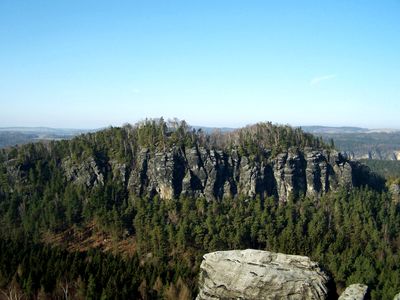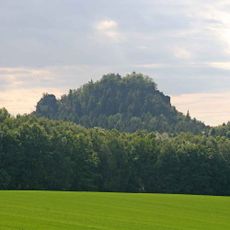
Großer Bärenstein, Table hill summit in Saxon Switzerland, Saxony, Germany
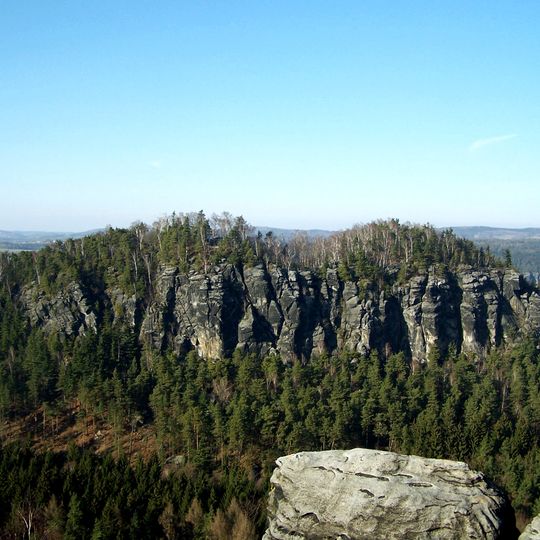
Großer Bärenstein is a 327-metre table hill in Saxon Switzerland, set on the plateau between Struppen, Naundorf, Weißig and Thürmsdorf. Its soft, heavily weathered sandstone is split by the Riegelhof, a steep gorge cutting in from the north that nearly divides the wooded summit in two. The rock falls away steeply to the south and east.
First documented in 1548 when records referred to it as 'im Behrenstein', this rock formation became an important reference point in the region's geography. Over time it developed into a popular destination for climbing and hiking activities.
The name Bärenstein means "Bear Rock". The first recognised climbing summit of the Bärensteine massif, the Bärensteinturm, was climbed in 1898; the main climbing rocks on the north side are the Khan and the Conradturm. The summit is reached only on unmarked paths, the main one from the south-west foot near Naundorf.
The main route starts at the southwestern foot of the rock and leads up from the direction of Naundorf; it is unmarked. On the north side the Riegelhofstiege climbs through a steep gorge and is rated difficult, comparable to a via ferrata. The former Angelasteig on the northeast side, near the Dreizack climbing rock, can now only be attempted with climbing skills.
The summit is split almost in two by the Riegelhof, a steep gorge cutting into the sandstone from the north; the Riegelhofstiege climbs through it. The rock is soft and heavily weathered, so the usual horizontal bedding of Elbe sandstone is largely absent, replaced by irregularly bent strata and oblique fissures. In March 1904 about 100 m³ of sandstone broke off the south wall.
The community of curious travelers
AroundUs brings together thousands of curated places, local tips, and hidden gems, enriched daily by 94,674 contributors worldwide.