Kirche, Romanesque church in Würzburg, Germany
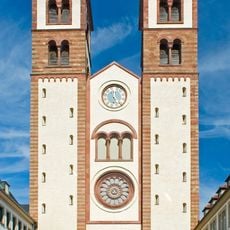
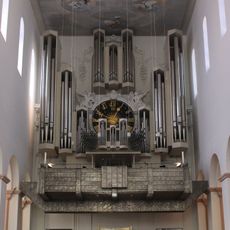
The Neumünster is a former collegiate church in Würzburg, built as a double-choir Romanesque basilica with two transepts. Its west choir was replaced between 1711 and 1716 by a high dome and a Baroque facade of red sandstone from the quarry "Schloß" between Leinach and Erlabrunn. The interior was redesigned from 1725 by the Zimmermann brothers.
Around 1057 Bishop Adalbero of Würzburg founded the collegiate church of Neumünster, dedicated to John the Evangelist, with support from Queen Richeza of Poland. The church was completed in the Romanesque style by 1060 and expanded from 1180 to 1250. In 1711–1716 Joseph Greissing built the Baroque west façade and dome, and from 1725 the Zimmermann brothers redesigned the interior. After wartime damage, it served as Würzburg's bishop's seat from 1950 to 1967.
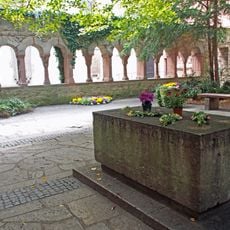
The church is dedicated to both John the Evangelist and John the Baptist, and since 1908 it has been a parish church separate from the cathedral. In the Lusam Garden at its north end stands a monument to the minstrel Walther von der Vogelweide, who was probably buried in the former cloister cemetery; the monument has circular hollows for birdseed and water so that birds can feed at his grave.
The Neumünster stands in Würzburg's city centre, a short walk from the cathedral, and is entered from the street side rather than through any fortress. The Lusamgärtchen, the small garden with the Walther von der Vogelweide monument and twelve surviving cloister arcades, lies at the church's north end and is reached separately from the interior.
The sandstone lid of Bishop Megingaud's sarcophagus, now in the crypt, carries the oldest monumental inscription in Franconia after Roman times. Megingaud died in 783 at Neustadt am Main Abbey, and the stone for the lid came from quarries around Neustadt.
The community of curious travelers
AroundUs brings together thousands of curated places, local tips, and hidden gems, enriched daily by 93,256 contributors worldwide.