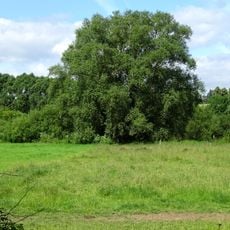
Beusterburg, Archaeological site and tourism office in Lower Saxony, Germany.
Beusterburg is a 15-hectare oval ring wall on the wooded Schiefer Berg in the Hildesheimer Wald, near Betheln in Lower Saxony. Its rampart, a 2.5–3.5 m deep ditch and an outer counterscarp bank enclose an area of about 500 by 420 m. Six Neolithic gaps about 1.5 m wide were found in the earthworks.
The ring wall is estimated to be 5,000 years old. Kurt Tackenberg excavated here in 1933, 1935 and 1936, finding pottery and flint tools attributed to the Michelsberg culture, while others argue for the Funnel Beaker culture. Later finds include Corded Ware sherds and, in 2001–2002, a bronze socketed axe fragment and a medieval sickle.
The name comes from the Beuster stream, which rises about 400 metres east of the wall. Excavations by Kurt Tackenberg in 1933, 1935 and 1936 found pottery, flint and flint blades but no house plans; he attributed the material to the Michelsberg culture, while others argued for the Funnel Beaker culture. Sherds of Corded Ware were also found.
Access is provided through marked paths leading to the grounds and visitor center. It is advisable to wear sturdy footwear, as the terrain can be uneven.
The site's name comes from the Beuster stream, which rises about 400 metres to the east. Excavations by Kurt Tackenberg in 1933, 1935 and 1936 found pottery, flint and flint blades but no house plans, and in 2001–2002 Erhard Cosack's metal-detector surveys turned up a fragment of a bronze socketed axe and a medieval sickle.
The community of curious travelers
AroundUs brings together thousands of curated places, local tips, and hidden gems, enriched daily by 94,814 contributors worldwide.