Schloss Rössing, Renaissance moated castle in Rössing, Nordstemmen, Germany
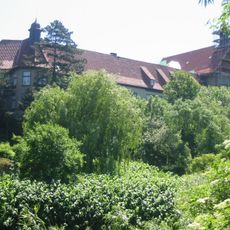
Schloss Rössing is a former moated castle east of the church in Rössing, part of Nordstemmen. Its three wings enclose a courtyard: the east wing dates from 1589, a timber-framed building on a rubble-stone base; the north wing was rebuilt in the second quarter of the 19th century; and a neo-Gothic extension was added to the west in 1909/10. A stair tower links the north and east wings.
The Lords of Rössing are documented in Rössing from 1132; their castle was first mentioned in 1133/34 when the Bishop of Hildesheim destroyed it. In 1431 Duke Wilhelm the Elder had the castle razed in the new Principality of Calenberg on condition it never be rebuilt. The present Renaissance palace was built by the von Rössing family between 1579 and 1589 and remains in their possession.
The name Rössing comes from the noble family documented in the village since 1132, whose castle was first mentioned in 1133/34. The family still owns the Schloss built between 1579 and 1589. The medieval water castle itself has vanished; only the field name "Burghof" recalls its former site.
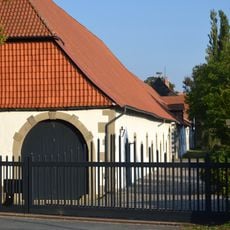
The complex lies east of Rössing's church, surrounded by a moat fed by the Rössingbach; the bridge over it dates from 1821, replacing an earlier drawbridge. The three wings and the farmyard southwest of them are private property of the von Rössing family, so the interiors are not open to visitors. The buildings can be viewed from the surrounding paths and from the churchyard.
The moat is fed by the Rössingbach stream, and the drawbridge that once crossed it was replaced by a fixed bridge in 1821. The name of the lost medieval water castle survives only in the field name "Burghof". The three-winged layout includes a stair tower linking the north and east wings.
The community of curious travelers
AroundUs brings together thousands of curated places, local tips, and hidden gems, enriched daily by 92,746 contributors worldwide.