Bonner Bogen, Architectural heritage monument in Beuel, Germany
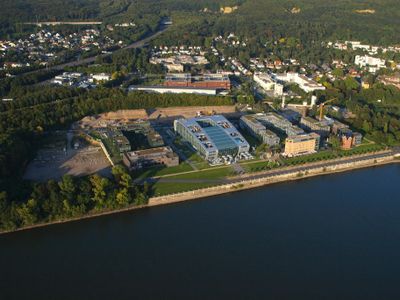
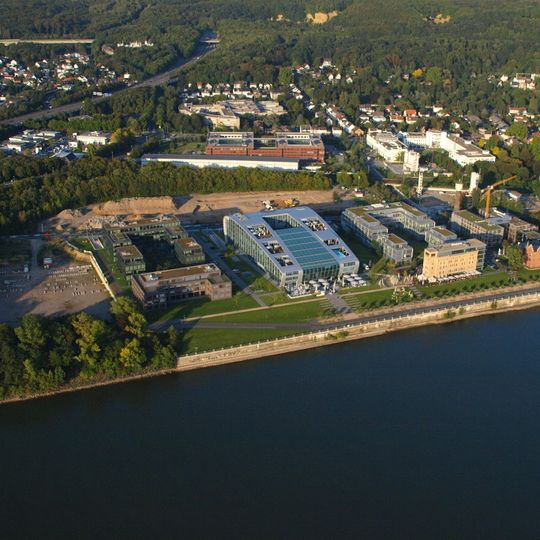
Bonner Bogen is a modern architectural complex situated along the Rhine waterfront in Beuel, featuring glass facades and geometric forms that stretch across the landscape. The ensemble combines offices, retail spaces, and exhibition areas into a cohesive whole.
Hermann Bleibtreu received permission to make Portland cement here on 12 June 1856, and production began in 1858 at the Bonner Portland-Zementwerk, the third such works in the German Confederation. Dyckerhoff took over the plant in 1985 and stopped production in 1986, closing it at the end of 1987. Demolition ran until 2002, leaving the listed Direktorenvilla, Rohmühle and Wasserturm.
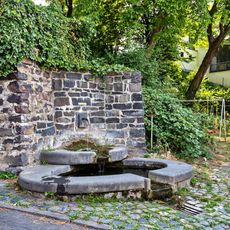
The name Bonner Bogen refers to the bend the Rhine makes here, secured by a wall of basalt blocks near the Konrad-Adenauer-Brücke. The preserved Rohmühle, where limestone and rock were ground for cement, and the 1897/98 water tower stand as listed monuments among the new office and hotel buildings. The Rheinwerkallee runs from Karl-Zuse-Platz past the water tower and ends between the Rohmühle and the Direktorenvilla.
The site lies on the right bank of the Rhine between Oberkassel and Ramersdorf, reached via Karl-Duwe-Straße, Joseph-Schumpeter-Allee, Oberkasseler Ufer and Hermann-Bleibtreu-Ufer. The Rheinuferpromenade runs along the river side, and the Rheinwerkallee crosses the grounds from Karl-Zuse-Platz past the water tower, ending between the Rohmühle and the Direktorenvilla. Bonn-Oberkassel station is nearby, and the Heinrich-Konen-Straße underpass opened in 2005.
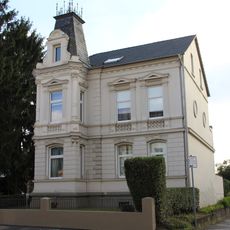
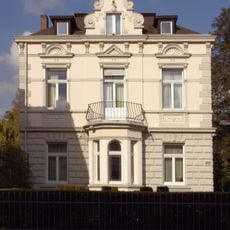
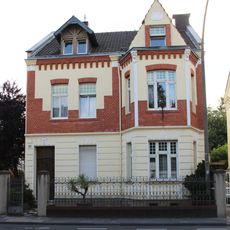
Three buildings from the cement works survive as listed monuments: the directors' villa, the Rohmühle where lime and rock were ground, and the 1897/98 water tower built to protect the plant from fire. The 60-metre chimney erected 1909–1911 by Hüser & Cie was not kept.
The community of curious travelers
AroundUs brings together thousands of curated places, local tips, and hidden gems, enriched daily by 93,819 contributors worldwide.